Earth and Space Sciences Regents, June 2025, question 4
Tap an image to open it full size.
What the figure shows
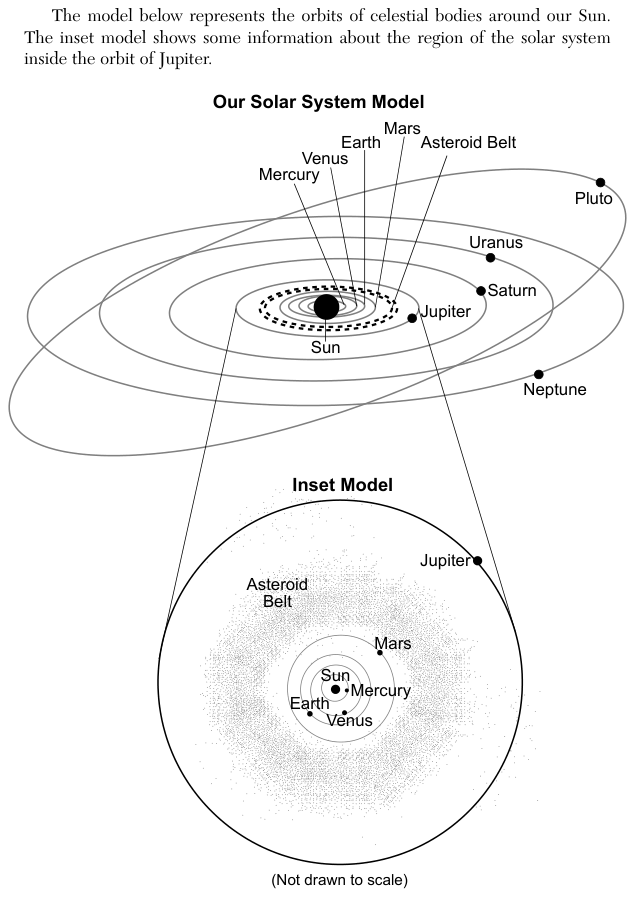
The "Our Solar System Model" shows the orbits of the planets, the asteroid belt and Pluto around the Sun. An inset enlarges the region inside the orbit of Jupiter, where Mercury, Venus, Earth and Mars orbit closest to the Sun, in that order outward. The model is not drawn to scale. The question describes a new planet whose average distance from the Sun lies between the distances of Mercury and Venus.
How to think about it
First place the new planet among the known planets by its distance from the Sun. Then use the rule that links a planet's distance from the Sun to its orbital speed: the Sun's gravity pulls harder on closer objects. The Solar System Objects Data Table on page 2 of the reference tables gives the mean distance from the Sun for each planet if you want to check the order.
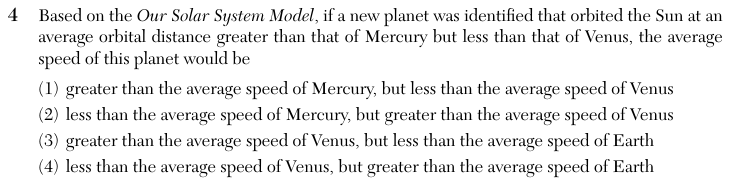
Based on the Our Solar System Model, if a new planet was identified that orbited the Sun at an average orbital distance greater than that of Mercury but less than that of Venus, the average speed of this planet would be
Choice 2 is right. Planets closer to the Sun feel a stronger pull of gravity and move faster in their orbits. The new planet is farther out than Mercury, so it moves more slowly than Mercury. It is closer than Venus, so it moves faster than Venus.
This choice reverses the relationship between distance and speed. It treats a planet farther from the Sun as faster, but orbital speed decreases as distance from the Sun increases.
This choice compares the new planet with the wrong pair of planets. The new planet lies between Mercury and Venus, not between Venus and Earth, and it is faster than both Venus and Earth.
This choice compares the new planet with Venus and Earth instead of Mercury and Venus. A planet closer to the Sun than Venus moves faster than Venus, not slower.