Earth and Space Sciences Regents, June 2025, question 35
Tap an image to open it full size.
What the figure shows
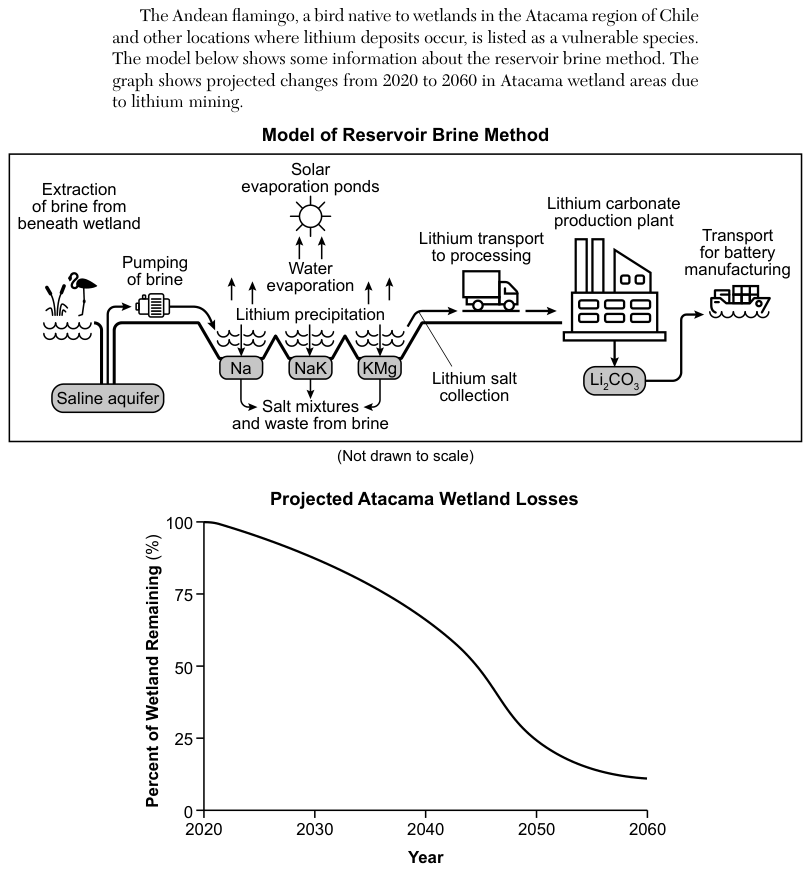
The passage says the Andean flamingo lives in wetlands of the Atacama region and is listed as a vulnerable species. The Model of Reservoir Brine Method shows brine extracted from a saline aquifer beneath a wetland, then pumped into a row of solar evaporation ponds. Water evaporates from the ponds, salt mixtures (Na, NaK, KMg) are removed as waste, and lithium salt is collected and taken to a lithium carbonate (Li2CO3) production plant. A graph, Projected Atacama Wetland Losses, shows the percent of wetland remaining falling from 100% in 2020 to about 11% in 2060.
How to think about it
Follow the arrows in the model from left to right. Note where the brine starts, where it is pumped to, and where the water evaporates from. Then ask which step takes water away from the place where the flamingos live.
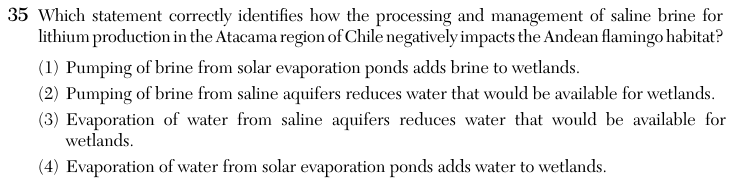
Which statement correctly identifies how the processing and management of saline brine for lithium production in the Atacama region of Chile negatively impacts the Andean flamingo habitat?
Choice 2 is right. The model shows brine pumped out of the saline aquifer that lies beneath the wetland. Removing that water leaves less water to supply the wetland, which fits the projected wetland losses in the graph. Less wetland means less habitat for the Andean flamingo.
The model shows brine pumped from the aquifer into the ponds, not from the ponds into the wetlands. This choice reverses the direction of the arrows.
Evaporation in the model happens in the solar evaporation ponds at the surface, not in the underground aquifer. This choice mixes up the two steps.
Water evaporating from the ponds goes into the air, as the upward arrows show. It is not added to the wetlands, so this choice describes a gain that the model does not show.