Earth and Space Sciences Regents, August 2025, question 25
Tap an image to open it full size.
What the figure shows
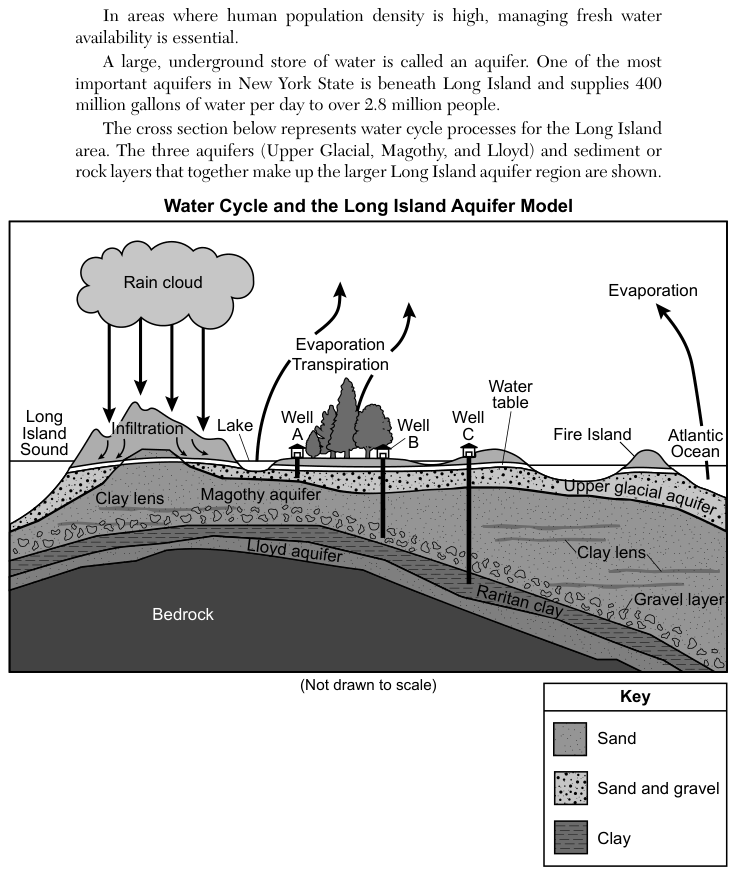
The cross section, Water Cycle and the Long Island Aquifer Model, shows layers under Long Island: an Upper glacial aquifer of sand and gravel near the surface, the Magothy aquifer of sand with a band of gravel pieces near its base, the Raritan clay, the Lloyd aquifer, and bedrock. The key shows sand, sand and gravel, and clay. Well B is the shorter well; its base ends in the band of gravel pieces at the bottom of the Magothy aquifer. Well C is deeper; its base ends in the Raritan clay layer. The diagram is not drawn to scale.
How to think about it
Find the bottom of each well and read which sediment it ends in, using the key. Then think about which property controls how fast water can flow through a sediment and into a well: how much space it holds, or how easily water passes through it.
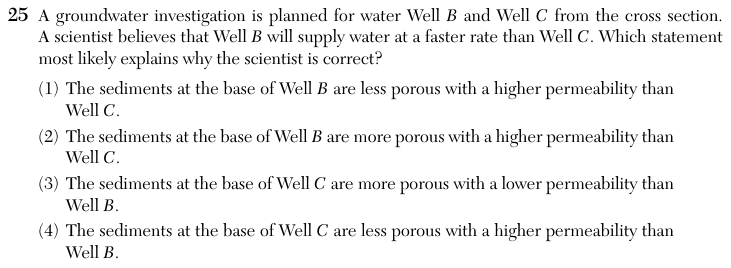
A groundwater investigation is planned for water Well B and Well C from the cross section. A scientist believes that Well B will supply water at a faster rate than Well C. Which statement most likely explains why the scientist is correct?
Choice 2 is the official answer. Well B ends in sand and gravel, while Well C ends in clay. Water moves easily through the large, connected openings between sand and gravel pieces, so this sediment has a high permeability. Clay has tiny openings that are poorly connected, so water moves through it very slowly. Higher permeability at the base of Well B is why it can supply water faster. Clay often holds more pore space than gravel, so the 'more porous' part of this choice is not reliable; what makes Well B supply water faster is permeability.
This choice gives Well B the higher permeability, which matches the well that ends in sand and gravel. It also says the Well B sediment is less porous, and measurements support that, since clay often holds more pore space than sand and gravel. The exam still keys choice 2, which gives Well B the same higher permeability.
This choice says the clay at Well C has the lower permeability, which is consistent with the diagram. It also says the clay is more porous, and measurements support that, since clay often holds more pore space than sand and gravel. The exam still keys choice 2, which states the same permeability difference from the side of Well B.
Clay does not have a higher permeability than sand and gravel. Its tiny pores let water pass only very slowly, so this choice reverses the permeability of the two sediments.