Earth and Space Sciences Regents, August 2025, question 29
Tap an image to open it full size.
What the figure shows
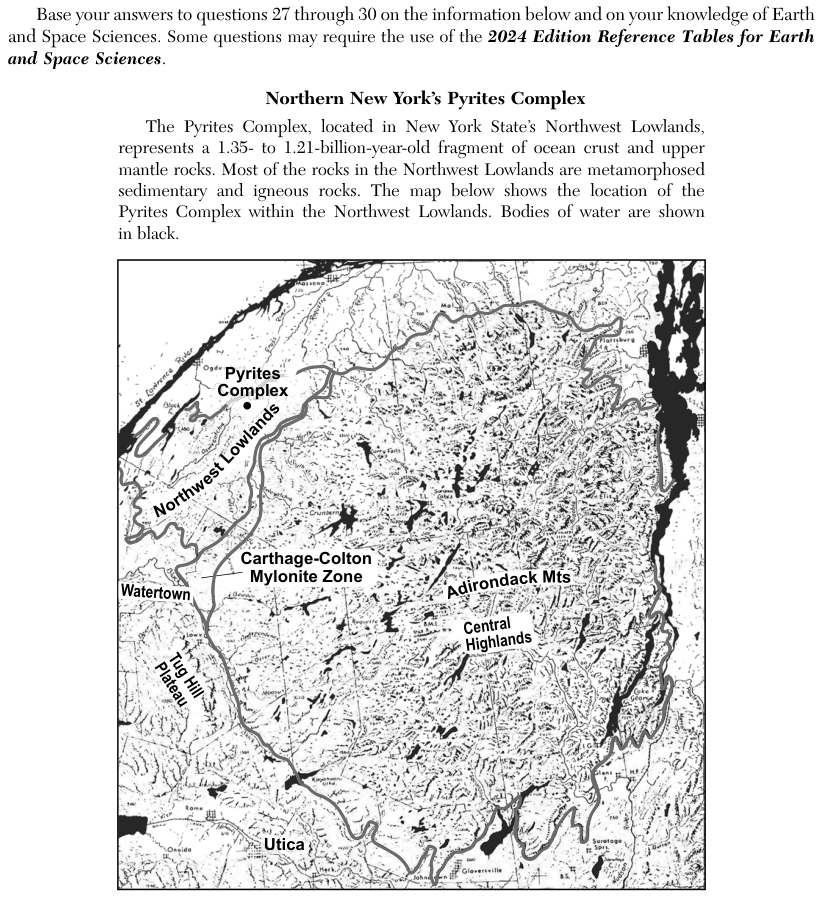
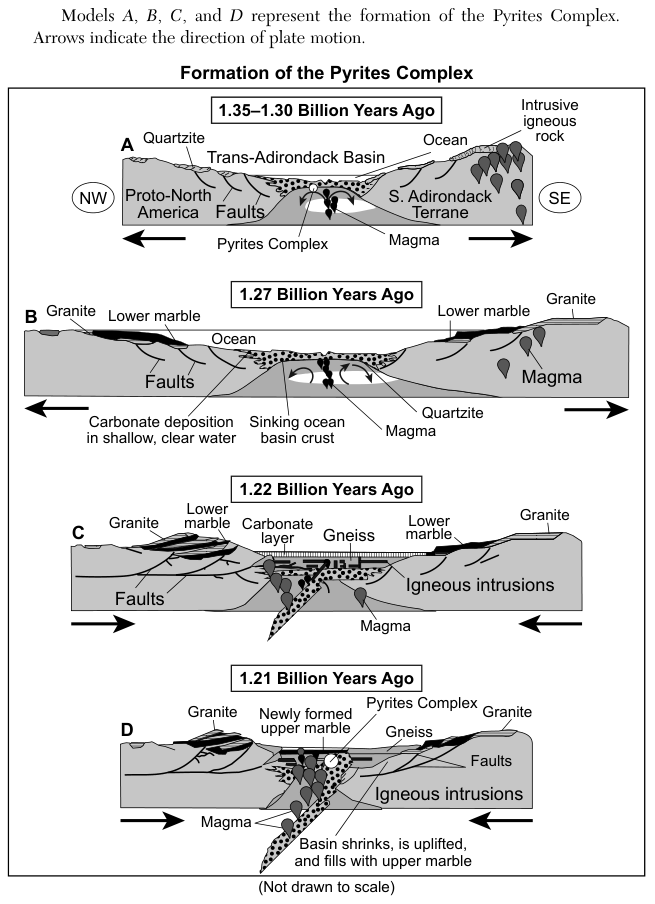
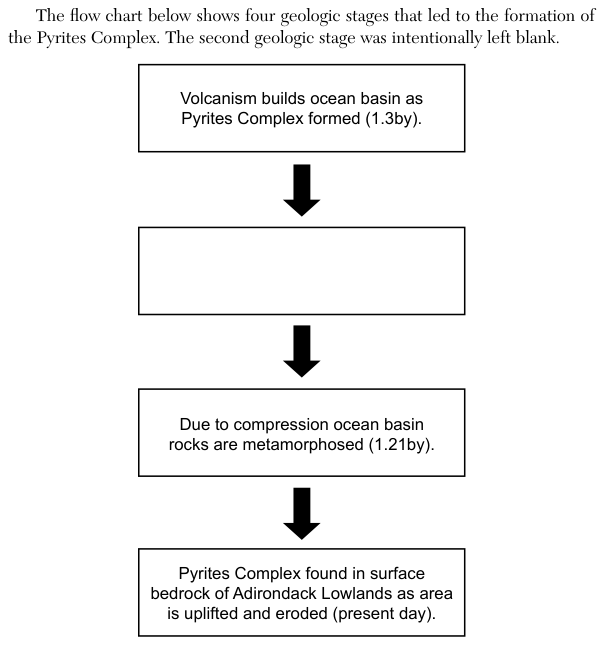
A flow chart has four stages. Stage 1: Volcanism builds ocean basin as Pyrites Complex formed (1.3by). Stage 2 is left blank. Stage 3: Due to compression ocean basin rocks are metamorphosed (1.21by). Stage 4: Pyrites Complex found in surface bedrock of Adirondack Lowlands as area is uplifted and eroded (present day). The Formation of the Pyrites Complex models show Model A (1.35 to 1.30 billion years ago) and Model B (1.27 billion years ago) with arrows pointing apart and magma rising under the ocean basin, and Model C (1.22 billion years ago) and Model D (1.21 billion years ago) with arrows pointing toward each other.
How to think about it
Find which model falls in time between stage 1 (1.3 billion years ago) and stage 3 (1.21 billion years ago). Look at the direction of its arrows and at what is happening to the ocean basin in that model, then pick the process that matches.
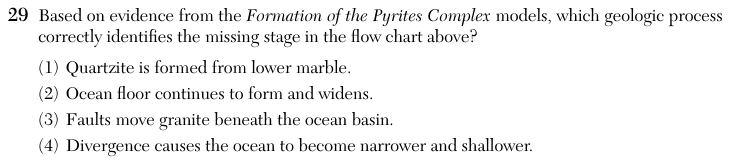
Based on evidence from the Formation of the Pyrites Complex models, which geologic process correctly identifies the missing stage in the flow chart above?
Choice 2 is right. Model B, at 1.27 billion years ago, falls between the first and third stages. Its arrows still point away from each other, magma still rises under the basin, and the basin is wider than in Model A. New ocean floor keeps forming and the ocean widens before compression begins.
Quartzite is already present in Model A, before the blank stage. Quartzite also forms from the metamorphism of sandstone, not marble, so lower marble cannot change into it. This choice may come from seeing quartzite and lower marble side by side in the models and reading one as formed from the other.
No model shows faults moving granite beneath the ocean basin. In Model C the granite and lower marble are pushed up on the sides of the basin, and it is oceanic crust that sinks beneath. This choice may come from the granite and the sinking oceanic crust being drawn close together in Model C.
Divergence means the plates move apart, which widens an ocean. A narrower basin comes from convergence, as in Models C and D. This choice mixes up the two kinds of plate motion.