Earth and Space Sciences Regents, August 2025, question 43
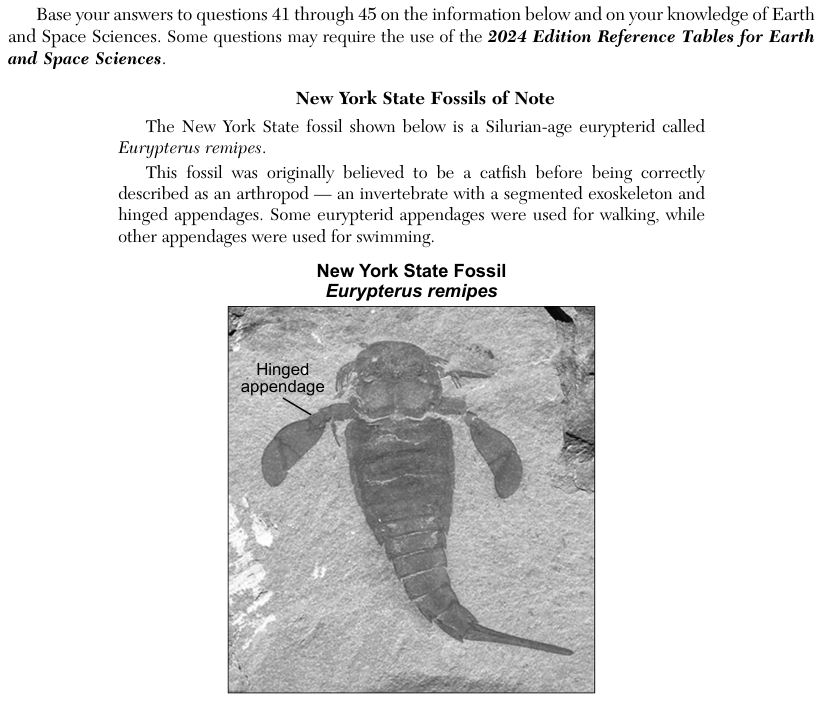
Tap an image to open it full size.
What the figure shows
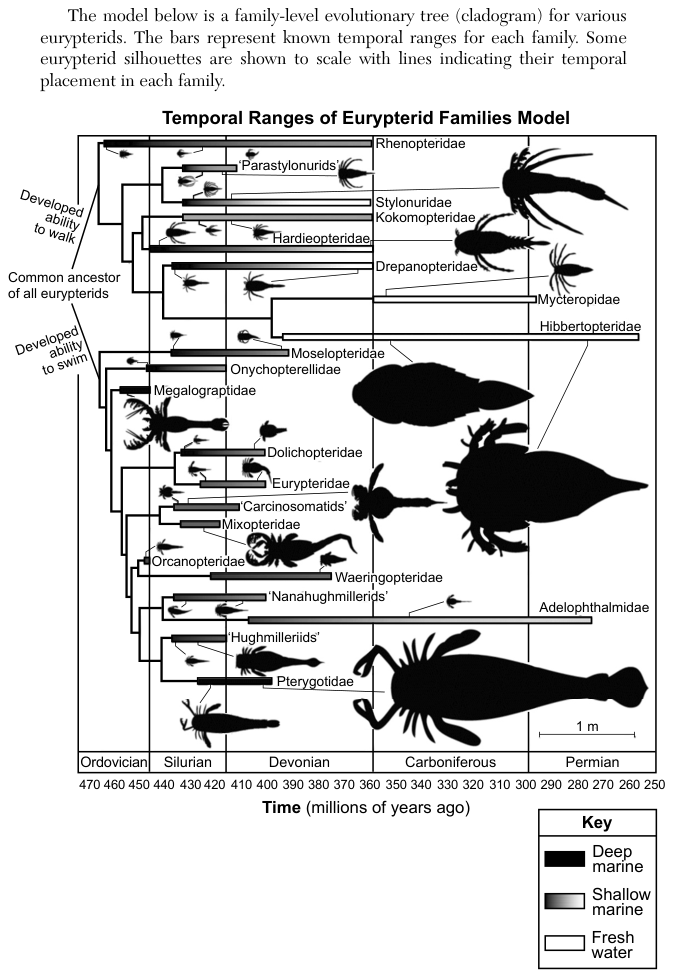
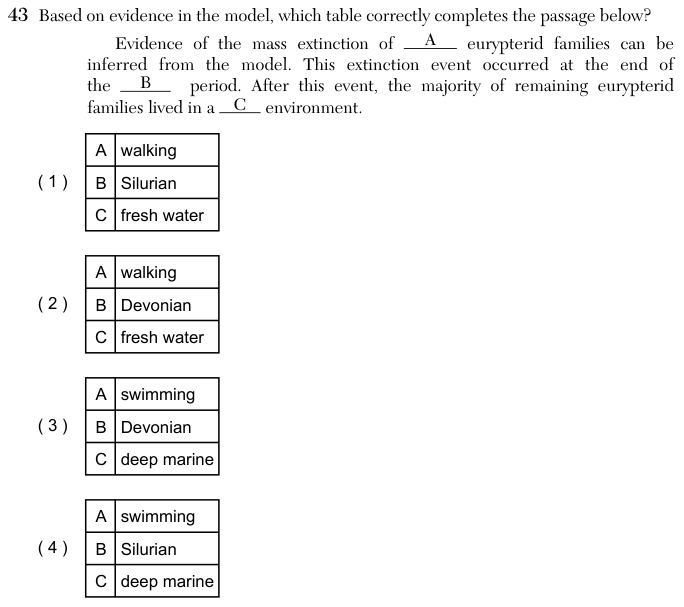
The passage has three blanks: the mass extinction of (A) eurypterid families, at the end of the (B) period, after which most remaining families lived in a (C) environment. Each choice is a small table filling A, B and C: choice 1 is walking, Silurian, fresh water; choice 2 is walking, Devonian, fresh water; choice 3 is swimming, Devonian, deep marine; choice 4 is swimming, Silurian, deep marine. The Temporal Ranges of Eurypterid Families Model is a family tree with one bar per family along a time axis from 470 to 250 million years ago, divided into the Ordovician, Silurian, Devonian, Carboniferous and Permian periods. One branch is labeled "Developed ability to walk" (Rhenopteridae down to Hibbertopteridae) and the other "Developed ability to swim" (Moselopteridae down to Pterygotidae); bar shading shows deep marine (black), shallow marine (gray) or fresh water (white).
How to think about it
Treat each bar as the time a family existed: its right end is when that family died out. Look for a place on the time axis where the right ends of many bars line up, and check which branch of the tree those families belong to. Then look at the shading of the bars that continue past that time.
Based on evidence in the model, which table correctly completes the passage below? Evidence of the mass extinction of A eurypterid families can be inferred from the model. This extinction event occurred at the end of the B period. After this event, the majority of remaining eurypterid families lived in a C environment.