Earth and Space Sciences Regents, August 2025, question 50
Tap an image to open it full size.
What the figure shows
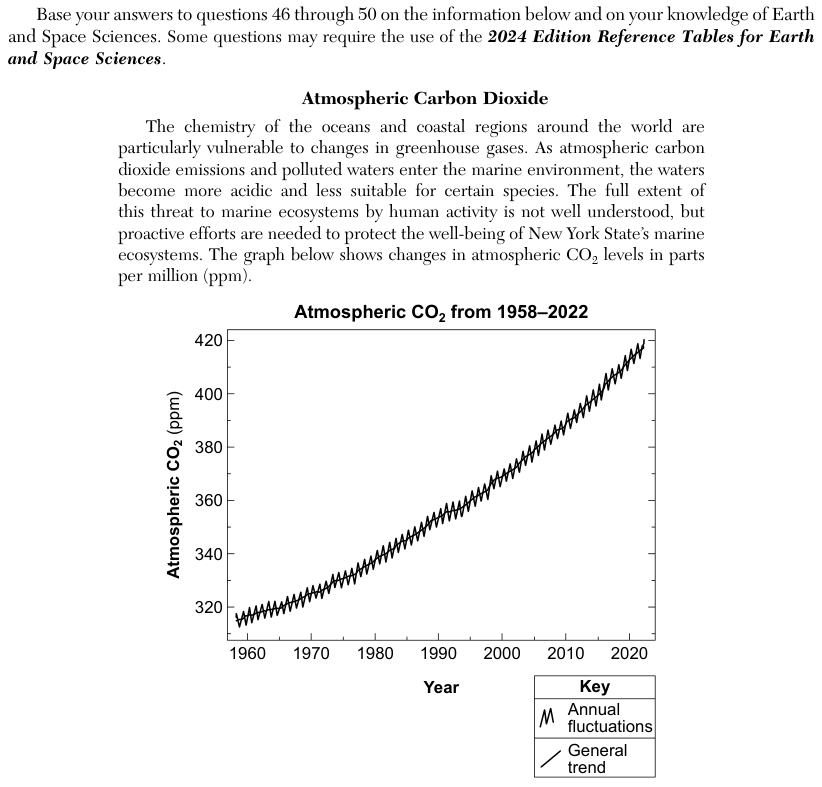
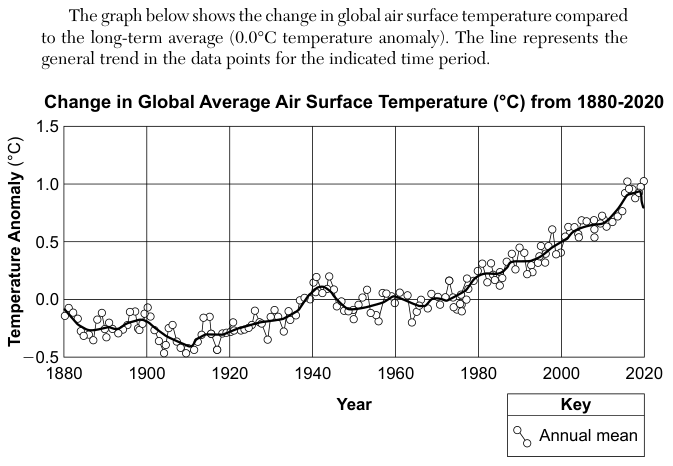
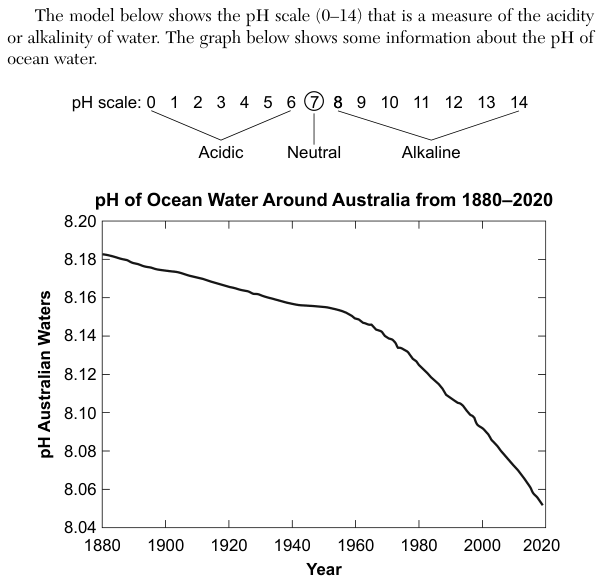
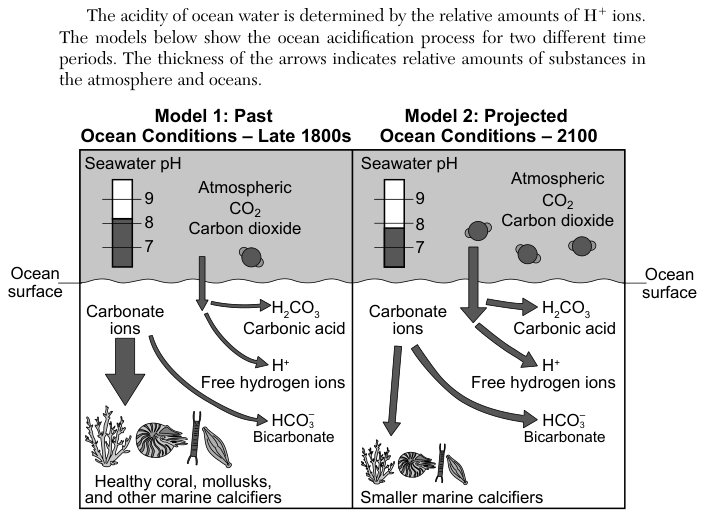
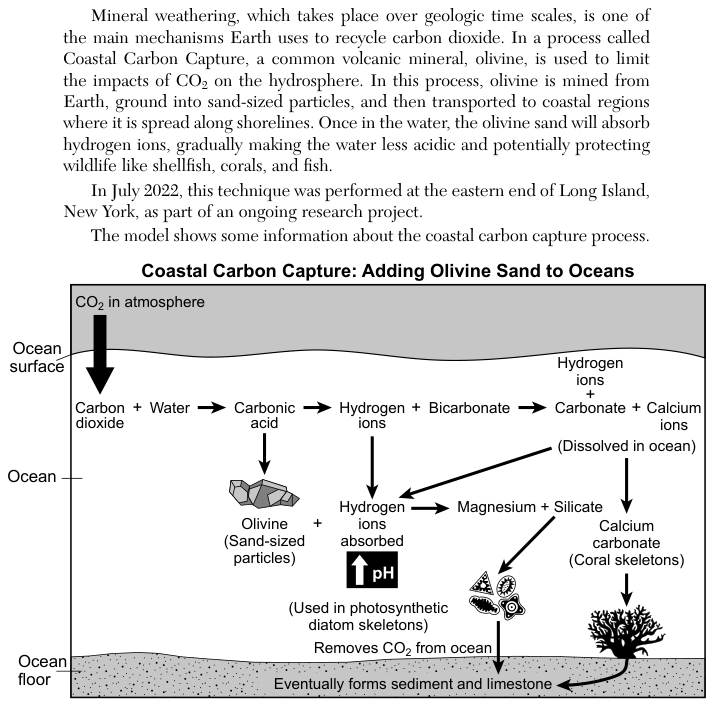
The passage says that in Coastal Carbon Capture, olivine, a common volcanic mineral, is mined, ground into sand-sized particles and spread along shorelines, where it absorbs hydrogen ions and gradually makes the water less acidic. The model Coastal Carbon Capture: Adding Olivine Sand to Oceans shows carbon dioxide from the atmosphere combining with water to form carbonic acid, then hydrogen ions and bicarbonate. Olivine plus hydrogen ions gives "Hydrogen ions absorbed" with an up arrow labeled pH, and then magnesium and silicate, which are used in diatom skeletons; the model prints "Removes CO2 from ocean" and "Eventually forms sediment and limestone". The pH scale model from earlier in the set labels 0 to 6 acidic, 7 neutral and 8 to 14 alkaline.
How to think about it
Each choice makes two claims: one about pH and one about the amount of carbon dioxide (CO2) in the ocean. Follow the arrows in the model from olivine onward, and read the labels for the direction pH changes and what happens to the carbon. Check both claims of a choice before accepting it.
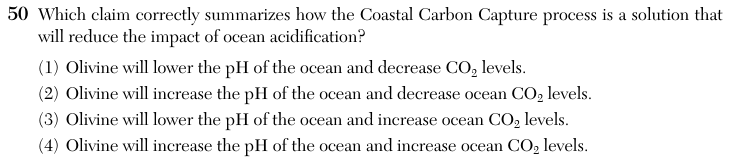
Which claim correctly summarizes how the Coastal Carbon Capture process is a solution that will reduce the impact of ocean acidification?
Choice 2 is right. The olivine sand absorbs hydrogen ions, and fewer hydrogen ions means a higher pH, as the up arrow labeled pH in the model shows. In the model, the magnesium and silicate released are used in diatom skeletons, and the model labels that step "Removes CO2 from ocean". The main chemical reason is that, with fewer hydrogen ions, more of the dissolved carbon stays in the water as bicarbonate instead of as carbon dioxide. A higher pH and less carbon dioxide in the water both work against ocean acidification.
Less carbon dioxide is correct, but olivine raises the pH, it does not lower it. Taking hydrogen ions out of the water makes it less acidic, which is a higher pH. This choice may come from mixing up 'less acidic' with 'lower pH'.
Both parts are reversed. Olivine raises the pH by absorbing hydrogen ions, and the model shows carbon dioxide being removed from the ocean, not added. These changes describe ocean acidification itself, not a solution to it.
The pH part is correct, but the model labels the process as removing carbon dioxide from the ocean. Adding carbon dioxide would form more carbonic acid and push the pH back down. This choice may come from seeing the large carbon dioxide arrow entering the ocean at the top of the model.