Earth and Space Sciences Regents, June 2026, question 21
Tap an image to open it full size.
What the figure shows
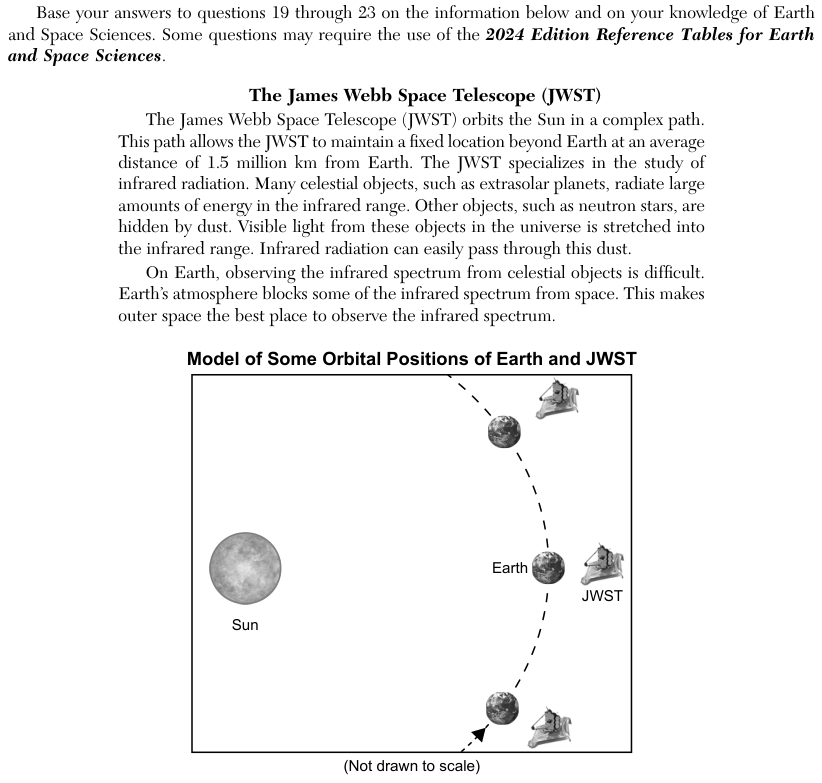
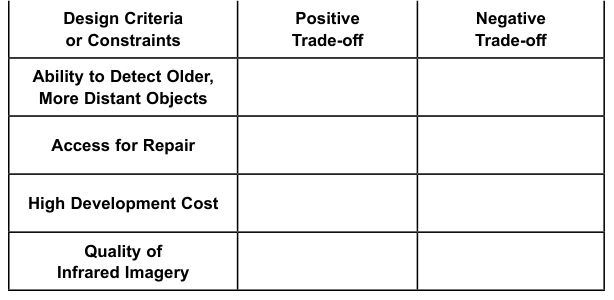
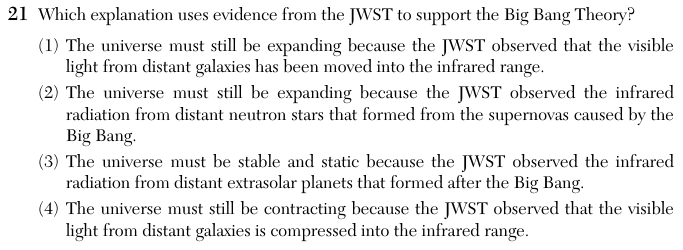
The passage says the James Webb Space Telescope (JWST) studies infrared radiation. It states that visible light from many objects in the universe is stretched into the infrared range, and that infrared radiation passes easily through dust that hides objects such as neutron stars. A table lists design criteria for the telescope (ability to detect older, more distant objects; access for repair; high development cost; quality of infrared imagery) with empty columns for positive and negative trade-offs. The four choices each state whether the universe is expanding, static or contracting, with a reason from a JWST observation.
How to think about it
Open the Portion of Electromagnetic Spectrum Related to Earth and Space Sciences and find where infrared lies compared with visible light. Then ask what it means for light from distant galaxies when its wavelength changes in that direction, and what that tells us about how galaxies move relative to us.
Which explanation uses evidence from the JWST to support the Big Bang Theory?
Choice 1 is right. Infrared radiation has longer wavelengths than visible light, so visible light moved into the infrared has been stretched to longer wavelengths. This is a redshift, and it shows that distant galaxies are moving away from us. Galaxies moving apart in every direction is evidence that the universe is expanding, which supports the Big Bang Theory.
Neutron stars form when massive stars explode as supernovas, long after the Big Bang, not as a direct product of it. Infrared radiation from a neutron star shows that the star exists, but it gives no evidence that galaxies are moving apart.
Planets around other stars do give off infrared radiation, but that does not show whether the universe is static. Light from distant galaxies is stretched to longer wavelengths, which shows the universe is expanding, not standing still.
Light that is compressed has shorter wavelengths and shifts toward the ultraviolet end of the spectrum, not toward the infrared. Infrared has longer wavelengths than visible light, so a shift into the infrared means stretching, which shows expansion. This choice may come from mixing up the directions of the spectrum.