Earth and Space Sciences Regents, June 2026, question 42
Tap an image to open it full size.
What the figure shows
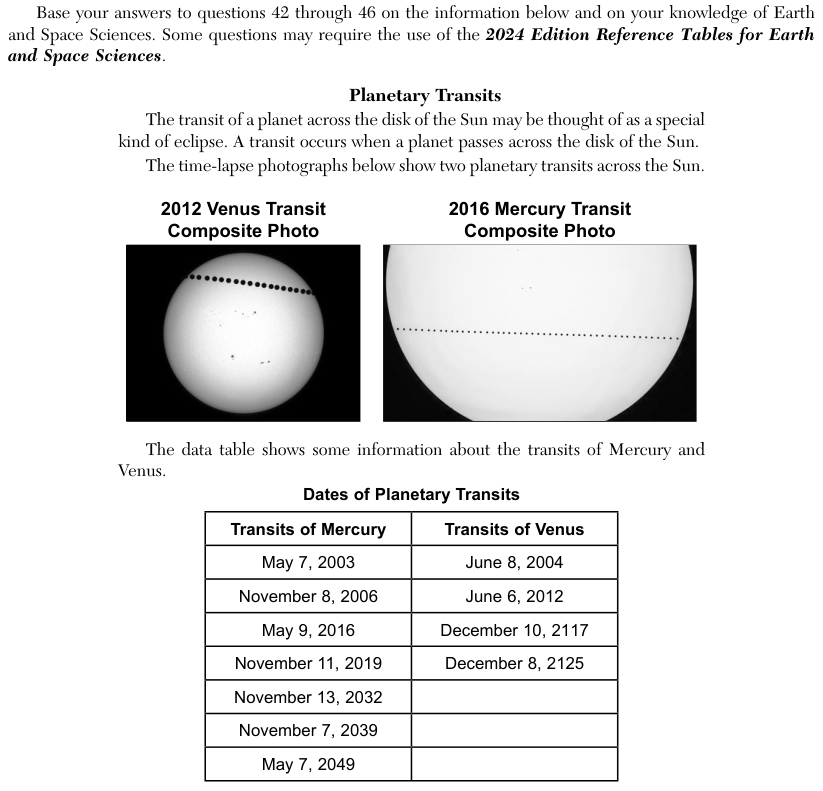
The passage, Planetary Transits, says a transit happens when a planet passes across the disk of the Sun. Two time-lapse photographs show the 2012 Venus transit and the 2016 Mercury transit as a line of dark dots crossing the bright Sun. A data table lists dates of transits of Mercury (from May 7, 2003 to May 7, 2049) and of Venus (June 8, 2004; June 6, 2012; December 10, 2117; December 8, 2125).
How to think about it
Read what the passage says a transit is, and look at the photographs and the table of transit dates. Then open the Solar System Objects Data Table. Check each proposed explanation against both the transit observations and the planetary data.
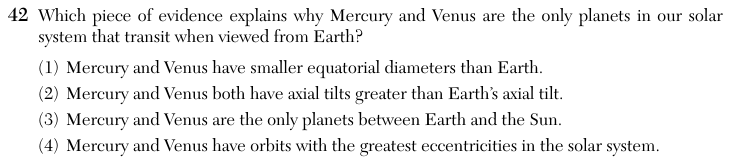
Which piece of evidence explains why Mercury and Venus are the only planets in our solar system that transit when viewed from Earth?
Choice 3 is right. A planet can only cross in front of the Sun, as seen from Earth, if its orbit lies between Earth and the Sun. The table shows Mercury at 57.9 million kilometers and Venus at 108.2 million kilometers from the Sun, both closer than Earth at 149.6 million kilometers. Every other planet is farther from the Sun than Earth, so it can never pass in front of the Sun from our view.
Mercury and Venus are smaller than Earth, but Mars (6792 kilometers) is smaller too, and Mars never transits. Size does not decide whether a planet passes between Earth and the Sun.
Venus has a large axial tilt (177.4 degrees), but Mercury's tilt is only 0.03 degrees, far less than Earth's 23.49 degrees. Axial tilt describes how a planet's axis leans and has nothing to do with whether the planet passes in front of the Sun.
Venus has the smallest eccentricity of any planet in the table (0.007), so this statement is false. The shape of an orbit does not place a planet between Earth and the Sun.