Earth and Space Sciences Regents, August 2026, question 27
Tap an image to open it full size.
What the figure shows
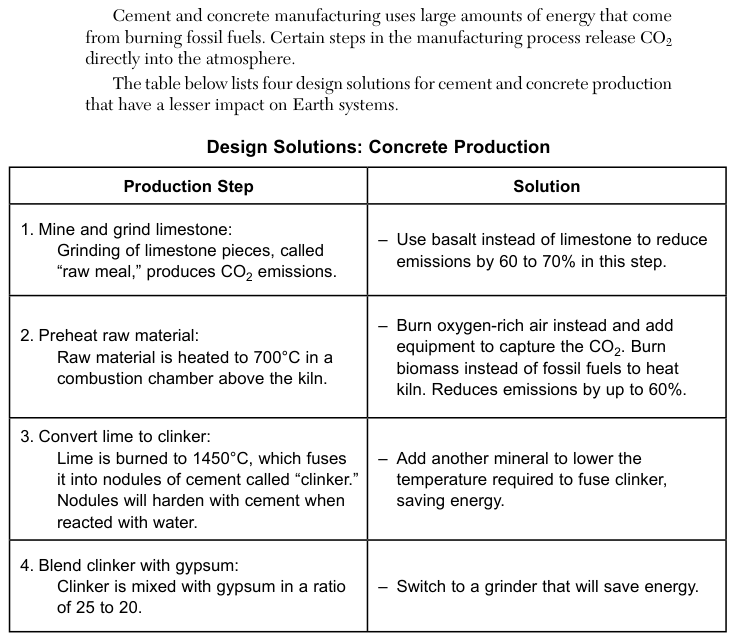
The table Design Solutions: Concrete Production lists four production steps and a solution for each. Step 1, Mine and grind limestone (grinding of limestone pieces, called raw meal, produces carbon dioxide (CO2) emissions): use basalt instead of limestone to reduce emissions by 60 to 70% in this step. Step 2, Preheat raw material (heated to 700 degrees Celsius (°C) in a combustion chamber above the kiln): burn oxygen-rich air instead and add equipment to capture the CO2; burn biomass instead of fossil fuels to heat the kiln; reduces emissions by up to 60%. Step 3, Convert lime to clinker (lime is burned to 1450°C, which fuses it into nodules called clinker): add another mineral to lower the temperature required to fuse clinker, saving energy. Step 4, Blend clinker with gypsum: switch to a grinder that will save energy.
How to think about it
Match each choice to its step in the Design Solutions table. Compare the action, the temperature and the percent in the choice with what the table says for that step. A choice cannot be the best benefit if it misstates what the table reports.
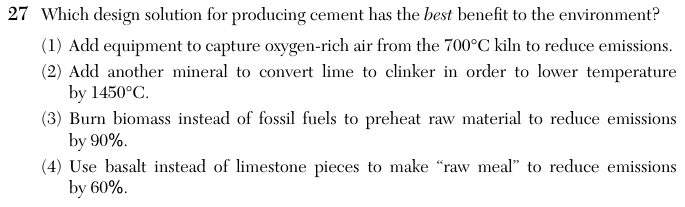
Which design solution for producing cement has the best benefit to the environment?
Choice 4 is right. The table says using basalt instead of limestone to make raw meal reduces carbon dioxide emissions by 60 to 70% in that step, so a 60% cut agrees with the table. It is the only choice that reports the table correctly, and it gives the largest stated cut in emissions.
The table says to burn the fuel in oxygen-rich air and add equipment to capture the carbon dioxide produced (the table's own words are burn oxygen-rich air, but air is not a fuel). It does not say to capture the oxygen-rich air. Capturing oxygen would not reduce carbon dioxide emissions.
The table says the added mineral lowers the temperature needed to fuse clinker, but it does not say by how much. Lowering 1450°C by 1450°C would mean 0°C. This choice may come from mixing up the process temperature with the size of the drop.
The table says the preheating step can reduce emissions by up to 60%, not 90%. The 90% figure does not appear in the table.