Earth and Space Sciences Regents, August 2026, question 47
Tap an image to open it full size.
What the figure shows
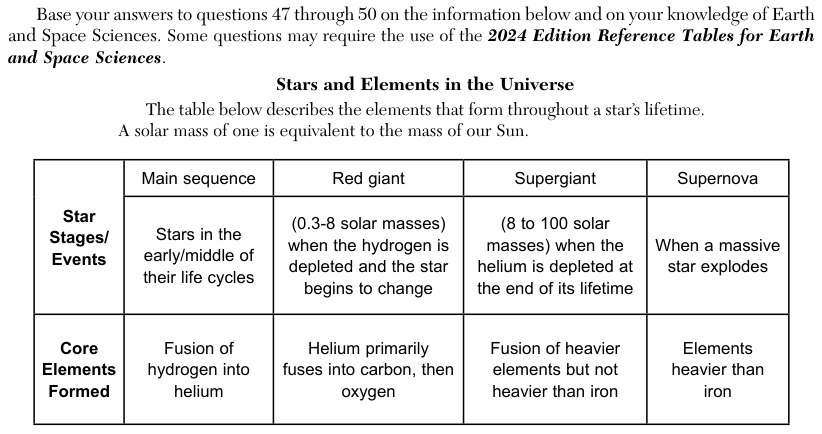
The passage, Stars and Elements in the Universe, has a table of star stages and the elements formed in the core at each. Main sequence: stars in the early or middle part of their life cycles; fusion of hydrogen into helium. Red giant (0.3 to 8 solar masses): when the hydrogen is depleted and the star begins to change; helium primarily fuses into carbon, then oxygen. Supergiant (8 to 100 solar masses): when helium is depleted at the end of its lifetime; fusion of heavier elements but not heavier than iron. Supernova: when a massive star explodes; elements heavier than iron. One solar mass equals the mass of our Sun.
How to think about it
Nucleosynthesis means the making of new elements inside a star. Read the table row by row and note what it says about each star at each stage, beside the elements its core forms. Then check each pair of factors in the choices against what the table uses to describe the stars.
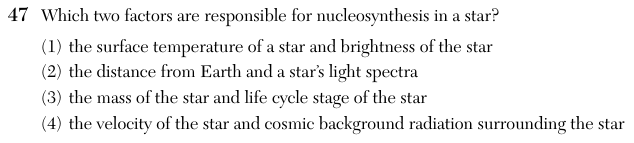
Which two factors are responsible for nucleosynthesis in a star?
Choice 3 is right. The table shows that the elements a star makes depend on its stage: hydrogen fuses into helium on the main sequence, then helium into carbon and oxygen in a red giant, and so on. It also shows that mass matters: the table lists supergiants as stars of 8 to 100 solar masses that fuse heavier elements up to iron, and it shows a massive star exploding as a supernova that forms elements heavier than iron.
Surface temperature and brightness are features seen from outside a star, as on the Hertzsprung-Russell (H-R) diagram. They are results of what happens in the core, not the causes of which elements form there.
A star's distance from Earth does not change what happens inside it. Its spectrum lets scientists identify elements that are already in the star, but it does not cause those elements to form.
A star's velocity and the cosmic background radiation are linked to the motion of stars and galaxies and to the early universe. Neither controls the fusion in a star's core, which depends on the star's mass and stage.