Earth and Space Sciences Regents, August 2026, question 50
Tap an image to open it full size.
What the figure shows
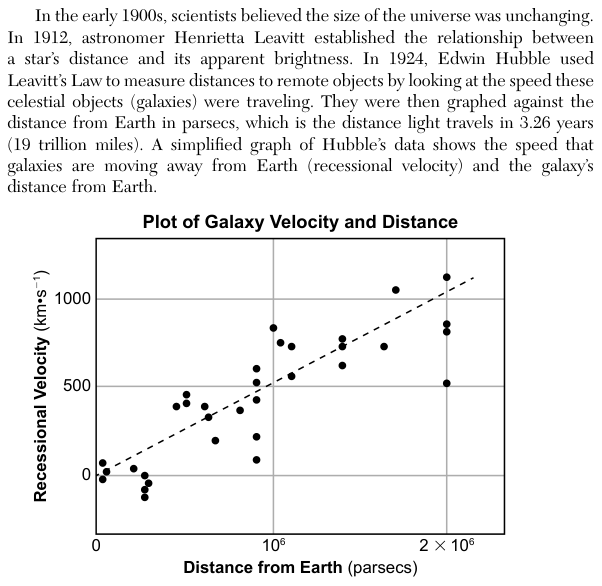
The passage says Edwin Hubble studied how fast galaxies were moving and how far they were from Earth. A graph, Plot of Galaxy Velocity and Distance, shows the speed at which galaxies move away from Earth (recessional velocity), in kilometers per second (km/s), against their distance from Earth in parsecs. The question asks which kind of evidence Hubble most likely used to measure the speeds of the galaxies.
How to think about it
Ask what a telescope can actually measure from a galaxy that is very far away. Then, for each kind of evidence, decide whether it would give the speed of the galaxy or some other property. The Portion of Electromagnetic Spectrum Related to Earth and Space Sciences shows which colors of visible light have longer and shorter wavelengths.
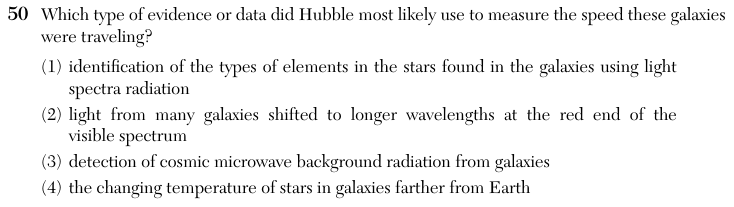
Which type of evidence or data did Hubble most likely use to measure the speed these galaxies were traveling?
Choice 2 is right. When a galaxy moves away from Earth, the dark lines in its light spectrum appear at longer wavelengths than the same lines measured in a laboratory. This is called a red shift, because longer visible wavelengths lie toward the red end of the spectrum (700 nanometers (nm) for red, 400 nm for violet). The size of the shift tells how fast the galaxy is moving away, so Hubble used red shift to find the speeds on the graph.
Spectra do tell which elements are in a galaxy's stars, but knowing the elements gives no speed. The speed comes from how far the lines of those elements have shifted, not from which elements are present. This choice may come from mixing up the two uses of a spectrum.
The cosmic microwave background radiation is a weak glow that fills the whole sky, left over from the early universe. It does not come from single galaxies and gives no speed for each galaxy. It was also first detected in 1964, long after Hubble's work in the 1920s.
The temperature of a star tells its color and type, not how fast its galaxy moves. Star temperatures do not change in a regular way with a galaxy's distance from Earth. This choice may come from confusing the color of a star with the shift of its spectral lines.