Earth and Space Sciences Regents, August 2025, question 5
Tap an image to open it full size.
What the figure shows
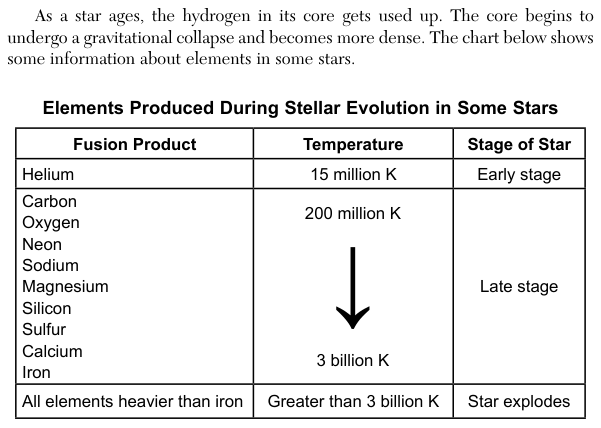
The passage says that as a star ages, the hydrogen in its core is used up and the core collapses and becomes more dense. The chart Elements Produced During Stellar Evolution in Some Stars lists: helium, 15 million kelvins (K), early stage; carbon, oxygen, neon, sodium, magnesium, silicon, sulfur, calcium and iron, from 200 million K down an arrow to 3 billion K, late stage; all elements heavier than iron, greater than 3 billion K, star explodes.
How to think about it
Read the chart row by row. For each row, note three things together: which elements are made, at what temperature, and at what stage of the star's life. Then test each claim against all three.
Which claim best describes the process of nucleosynthesis in a star?
Choice 3 is right. The chart shows helium made early at 15 million K. Carbon through iron are made in the late stage, at 200 million K to 3 billion K. In the chart's simplified model of a massive star, the elements heavier than iron come last, at more than 3 billion K, when the star explodes. Real stars also make some heavier elements in other ways that the chart does not show. So heavier elements form later in a star's life, at higher temperatures.
The lightest product in the chart, helium, is made in the early stage, not near the end of the star's life. This choice may come from linking the end of the life cycle with the wrong end of the chart.
The chart shows that a supernova (when the star explodes) makes the elements heavier than iron at temperatures greater than 3 billion K. That is the highest temperature in the chart, and the products are the heaviest elements, not the lightest. This choice may come from reading the chart from the wrong end, so that the explosion row seems to hold the lightest elements and the lowest temperatures.
This choice reverses the pattern in the chart. Helium, the lightest product, forms at 15 million K, while heavier elements form at 200 million K to more than 3 billion K.