Earth and Space Sciences Regents, August 2025, question 31
Tap an image to open it full size.
What the figure shows
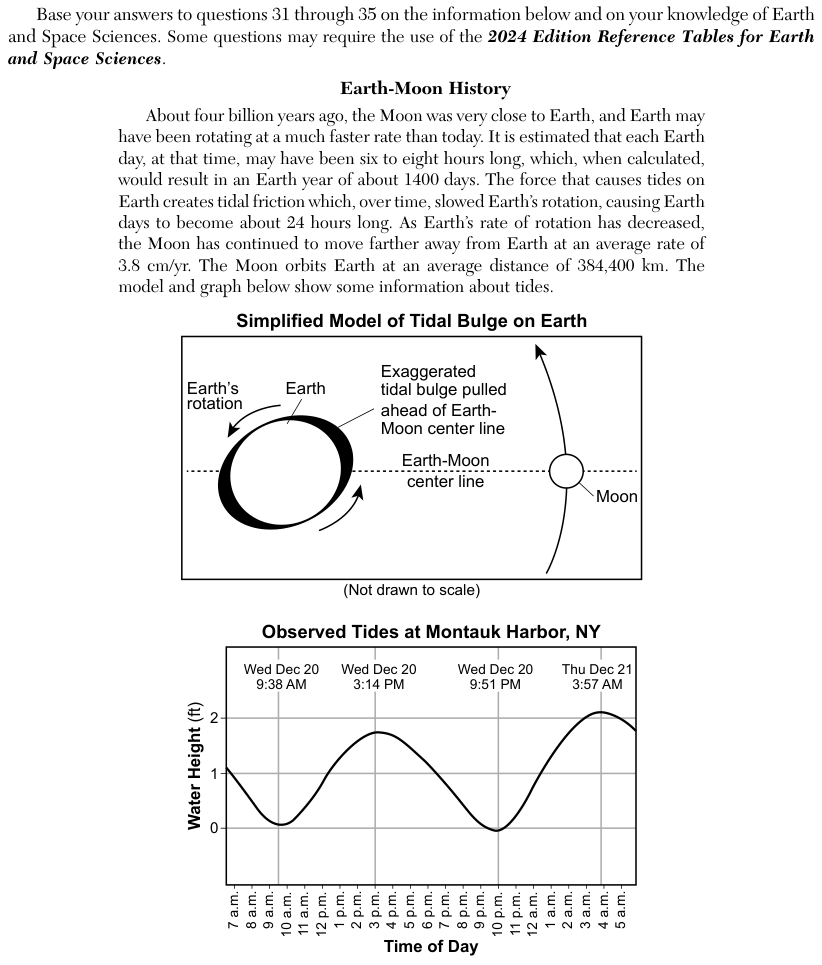
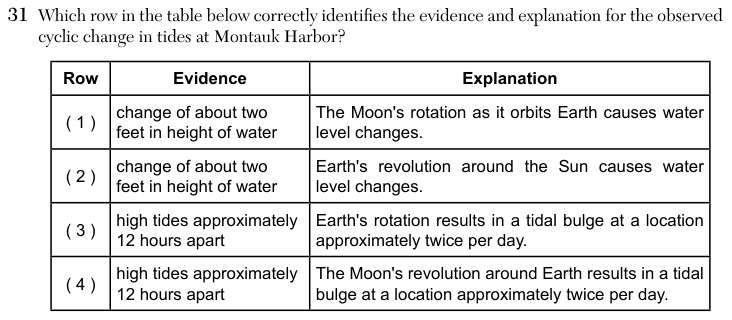
The passage, Earth-Moon History, says that the force that causes tides creates tidal friction, which has slowed Earth's rotation, and that the Moon orbits Earth at an average distance of 384,400 kilometers (km). A model, Simplified Model of Tidal Bulge on Earth, shows Earth rotating, the Moon on its orbit, and an exaggerated tidal bulge pulled ahead of the Earth-Moon center line. A graph, Observed Tides at Montauk Harbor, NY, plots water height in feet (ft) against time of day: low water at Wed Dec 20 9:38 AM, high water (about 1.7 ft) at 3:14 PM, low water at 9:51 PM, and high water (about 2.1 ft) at Thu Dec 21 3:57 AM. The choices are a table with four rows, each pairing a piece of evidence with an explanation.
How to think about it
The question asks about a cyclic change in the tides. First read the graph: the times of the low and high tides, and the water heights. Then take each row of the table and check two things: whether its evidence matches the graph and supports the claim in the question, and whether the motion it names could produce that evidence.
Which row in the table below correctly identifies the evidence and explanation for the observed cyclic change in tides at Montauk Harbor? Row Evidence Explanation
Choice 3 is right. On the graph the high tides come at 3:14 PM and 3:57 AM, about 12 hours apart, and this regular timing is the evidence of a cycle. The Moon's gravity raises two tidal bulges on Earth. Earth's rotation carries Montauk Harbor through both bulges in about one day, so the harbor has a high tide about every 12 hours.
A change of about two feet tells how large the tides are, not that they repeat, so it is weak evidence of a cycle. Also, the Moon's own spin does not raise tides; tides come from the Moon's gravity pulling on Earth's water.
Earth's revolution around the Sun takes about 365 days. A motion that takes a year cannot produce a rise and fall of water that repeats twice each day. This row may come from mixing up the causes of the seasons and the causes of tides.
The evidence in this row is right, but the explanation is not. The Moon takes about 27 days to go once around Earth, which is far too slow to bring a location into a bulge twice a day. This choice may come from mixing up the Moon's revolution with Earth's rotation.