Earth and Space Sciences Regents, August 2025, question 34
Tap an image to open it full size.
What the figure shows
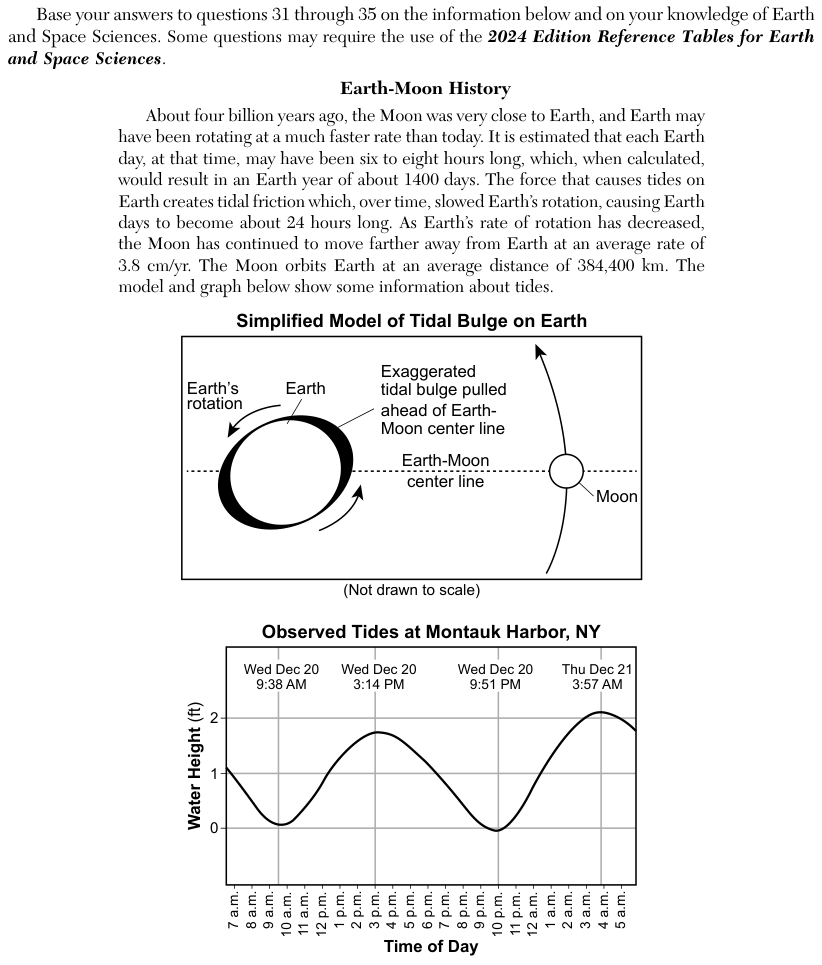
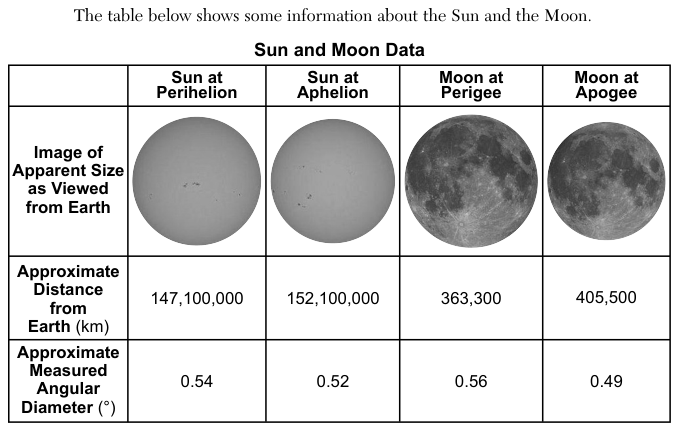
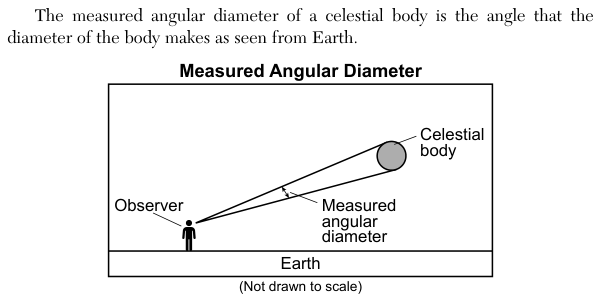
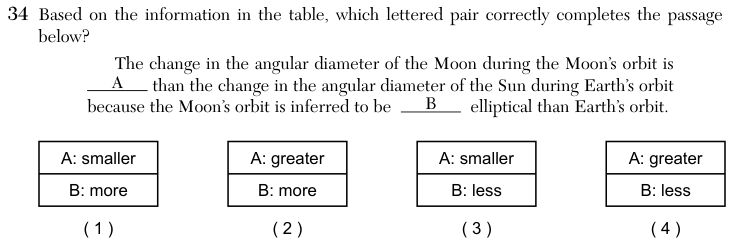
A table, Sun and Moon Data, shows images of apparent size and gives approximate distance from Earth in kilometers (km) and approximate measured angular diameter in degrees. Sun at perihelion: 147,100,000 km, 0.54. Sun at aphelion: 152,100,000 km, 0.52. Moon at perigee: 363,300 km, 0.56. Moon at apogee: 405,500 km, 0.49. A diagram defines measured angular diameter as the angle that the diameter of a body makes as seen by an observer on Earth. The four choices fill blank A with smaller or greater and blank B with more or less: (1) smaller, more; (2) greater, more; (3) smaller, less; (4) greater, less.
How to think about it
Work out blank A first. For each body, subtract its smallest angular diameter from its largest, then compare the two changes. For blank B, think about what makes the apparent size of a body change during its orbit: a change in its distance from Earth. An orbit that is close to a circle keeps the distance nearly the same.
Based on the information in the table, which lettered pair correctly completes the passage below? The change in the angular diameter of the Moon during the Moon’s orbit is A than the change in the angular diameter of the Sun during Earth’s orbit because the Moon’s orbit is inferred to be B elliptical than Earth’s orbit.
Choice 2 is right. The Moon's angular diameter changes from 0.56 to 0.49 degrees, a change of 0.07 degrees, while the Sun's changes from 0.54 to 0.52 degrees, a change of only 0.02 degrees. So the change for the Moon is greater. Eccentricity depends on how much the distance varies compared with the average distance, not on the size of the change in kilometers. The Moon's distance varies by about 11 percent of its average distance, while the Earth to Sun distance varies by only about 3 percent. The larger change in the Moon's apparent size reflects this larger relative variation, so the Moon's orbit is more elliptical than Earth's orbit. The Solar System Objects Data Table agrees: the eccentricity of the Moon's orbit is 0.055 and that of Earth's orbit is 0.017.
Blank B is right, but blank A is not. The Moon's angular diameter changes by 0.07 degrees and the Sun's by 0.02 degrees, so the Moon's change is greater, not smaller. This may come from comparing the sizes of the angles instead of the sizes of the changes.
Both blanks are reversed. The Moon's angular diameter changes more than the Sun's, and a larger change in apparent size points to a more elliptical orbit, not a less elliptical one.
Blank A is right, but blank B is not. A greater change in apparent size means the distance to the Moon changes by a larger share of its average distance during its orbit. That is the sign of a more elliptical orbit, so less elliptical reverses the relationship.