Earth and Space Sciences Regents, January 2026, question 14
Tap an image to open it full size.
What the figure shows
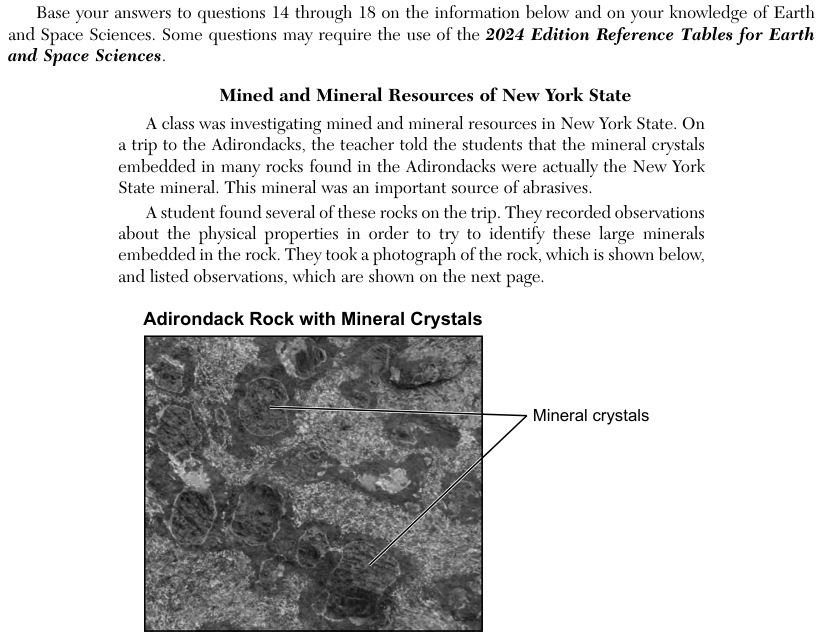
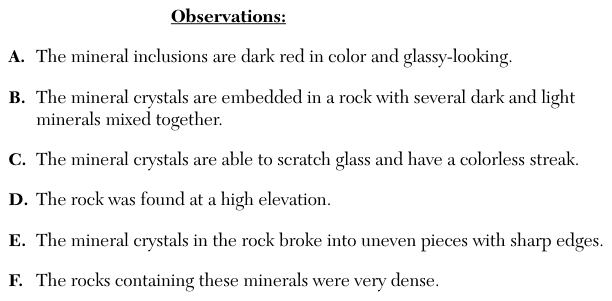
The passage says a teacher told a class that the mineral crystals in many Adirondack rocks were the New York State mineral, an important source of abrasives. A photograph, Adirondack Rock with Mineral Crystals, shows large rounded crystals set in a speckled rock. A student listed six observations: A, the inclusions are dark red and glassy-looking; B, the crystals are embedded in a rock with several dark and light minerals mixed together; C, the crystals can scratch glass and have a colorless streak; D, the rock was found at a high elevation; E, the crystals broke into uneven pieces with sharp edges; F, the rocks containing these minerals were very dense.
How to think about it
Open the Mineral Identification Flowchart. It starts with luster, then hardness compared with glass, then cleavage or fracture, then color and streak. For each observation, ask whether it is a property the flowchart can use.
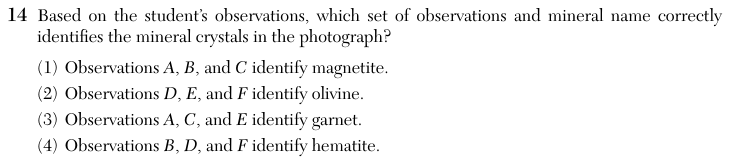
Based on the student’s observations, which set of observations and mineral name correctly identifies the mineral crystals in the photograph?
Choice 3 is right. Observations A, C and E are all properties of the crystals: dark red color with a glassy luster, harder than glass with a colorless streak, and breaking unevenly rather than along cleavage planes. On the Mineral Identification Flowchart these lead through nonmetallic, harder than glass, poor or no cleavage to garnet: color often dark red, vitreous luster, hardness 7 to 7.5, colorless streak. Garnet is also the New York State mineral and is mined for abrasives in the Adirondacks.
Magnetite is metallic, black, with a black to gray streak, and is strongly magnetic. Observations A and C (dark red, glassy, colorless streak) do not fit it, and observation B describes the rock around the crystals, not the crystals.
Observation D is about where the rock was found and F is about the whole rock, so neither identifies a mineral. Olivine is usually green, in grains like sand, which does not match the dark red crystals.
Observations B, D and F describe the rock and its location, not the crystals' own properties. Hematite has a red-brown streak, while these crystals leave a colorless streak. This choice may come from linking the red color to hematite without checking the streak.