Earth and Space Sciences Regents, January 2026, question 50
Tap an image to open it full size.
What the figure shows
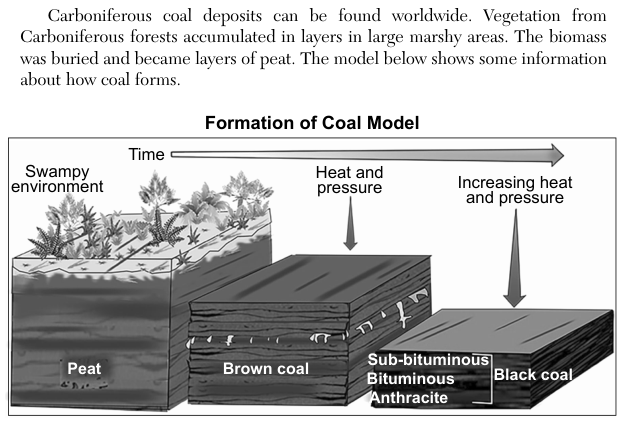
The passage says Carboniferous coal deposits are found worldwide, and that plant material from Carboniferous forests built up in layers in large marshy areas, was buried, and became layers of peat. The Formation of Coal Model shows, from left to right along an arrow labeled Time: a swampy environment with plants above a layer of peat; then brown coal, under an arrow labeled Heat and pressure; then black coal (sub-bituminous, bituminous and anthracite), under an arrow labeled Increasing heat and pressure. Each of the four choices names a New York city, a landscape region, and a material with a statement about coal.
How to think about it
First use the coal model to put the materials in order as heat and pressure increase. Then find each city on the Energy and Mineral Resources of New York State map, and its landscape region on the Geographic Province and Landscape Regions of New York State map. A choice must be correct in all three parts: the material, the order of coal formation, and the region.
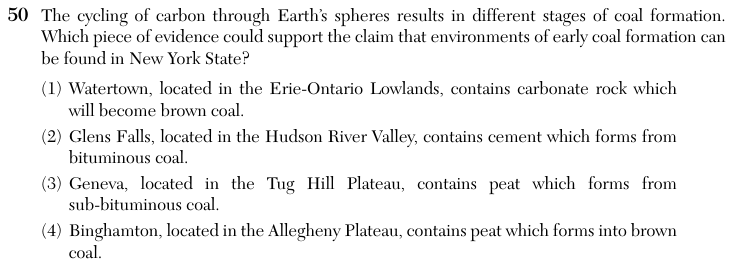
The cycling of carbon through Earth’s spheres results in different stages of coal formation. Which piece of evidence could support the claim that environments of early coal formation can be found in New York State?
Choice 4 is right. The Energy and Mineral Resources of New York State map shows peat (P) at Binghamton, and the landscape regions map places Binghamton in the Allegheny Plateau. The coal model shows that peat is the first stage and, with heat and pressure, becomes brown coal. Peat that forms in a swampy setting is evidence of an environment of early coal formation.
Carbonate rock, such as limestone, forms mostly from shells and minerals that settle in the sea. It is not buried plant material, so it does not become brown coal. The model shows that brown coal forms from peat.
Cement is a resource made from carbonate rock and shale. It does not form from bituminous coal. Glens Falls does have cement on the resource map, but cement is not a stage in coal formation.
This choice reverses the order in the model. Peat comes first and later becomes coal; it does not form from sub-bituminous coal. Geneva also lies in the Erie-Ontario Lowlands, not the Tug Hill Plateau.