Earth and Space Sciences Regents, June 2026, question 31

Tap an image to open it full size.
What the figure shows
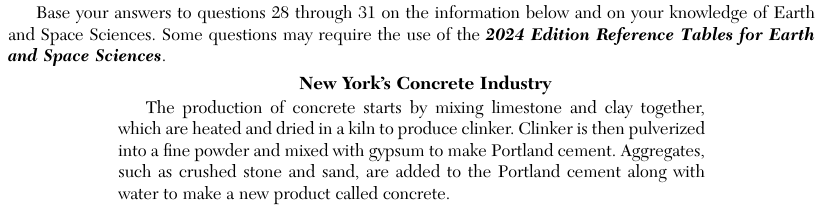
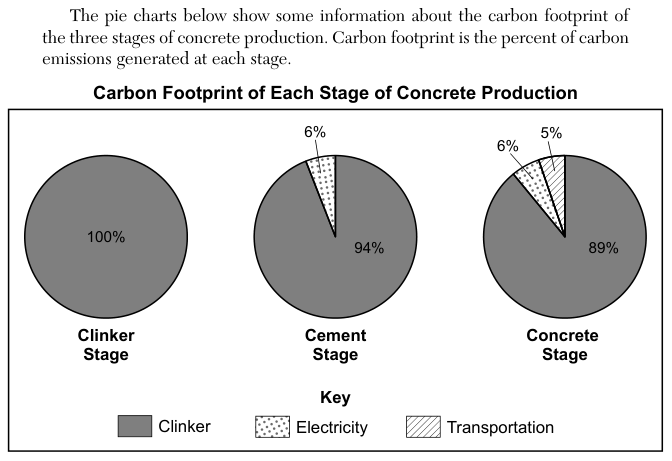
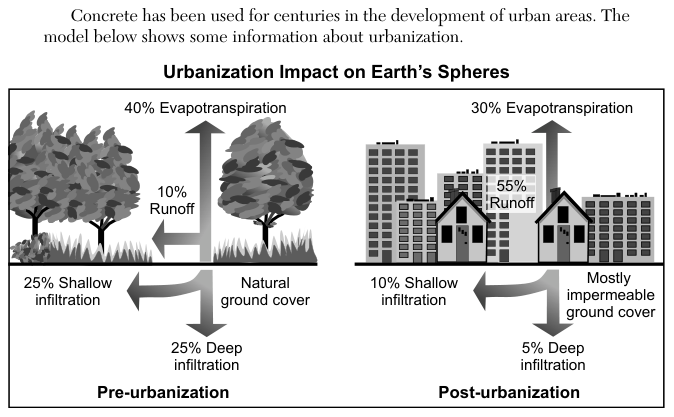
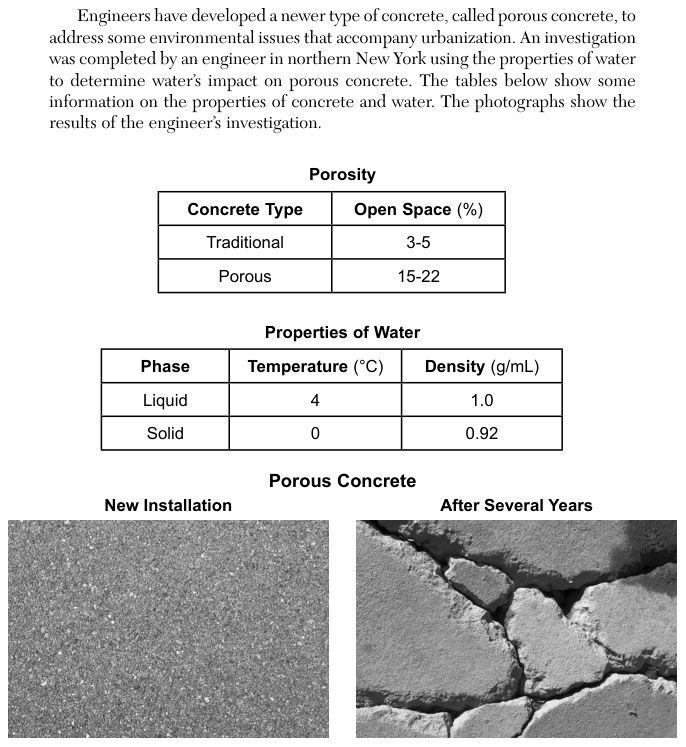
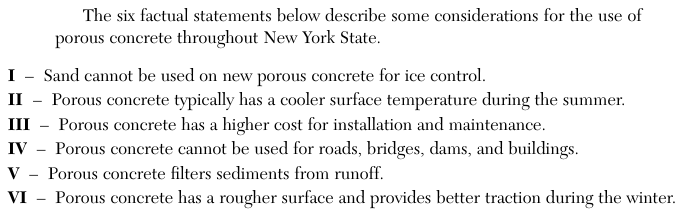
A model, Urbanization Impact on Earth's Spheres, compares two landscapes. Pre-urbanization (natural ground cover): 40% evapotranspiration, 10% runoff, 25% shallow infiltration, 25% deep infiltration. Post-urbanization (mostly impermeable ground cover): 30% evapotranspiration, 55% runoff, 10% shallow infiltration, 5% deep infiltration. A Porosity table gives open space of 3-5% for traditional concrete and 15-22% for porous concrete. A Properties of Water table gives liquid water at 4 degrees Celsius (°C) with density 1.0 grams per milliliter (g/mL) and solid water at 0 °C with density 0.92 g/mL. Two photographs show porous concrete as a new installation and, after several years, broken into cracked pieces. Six factual statements follow: I, sand cannot be used on new porous concrete for ice control; II, porous concrete typically has a cooler surface temperature during the summer; III, porous concrete has a higher cost for installation and maintenance; IV, porous concrete cannot be used for roads, bridges, dams and buildings; V, porous concrete filters sediments from runoff; VI, porous concrete has a rougher surface and provides better traction during the winter.
How to think about it
A constraint is a limit or drawback that makes a design harder to use. For each of the six statements, decide whether it describes an advantage of porous concrete or a limit of porous concrete. Then check both statements in each pair.
Which two statements identify constraints that would support the choice of traditional concrete over porous concrete?