Earth and Space Sciences Regents, June 2026, question 32
Tap an image to open it full size.
What the figure shows
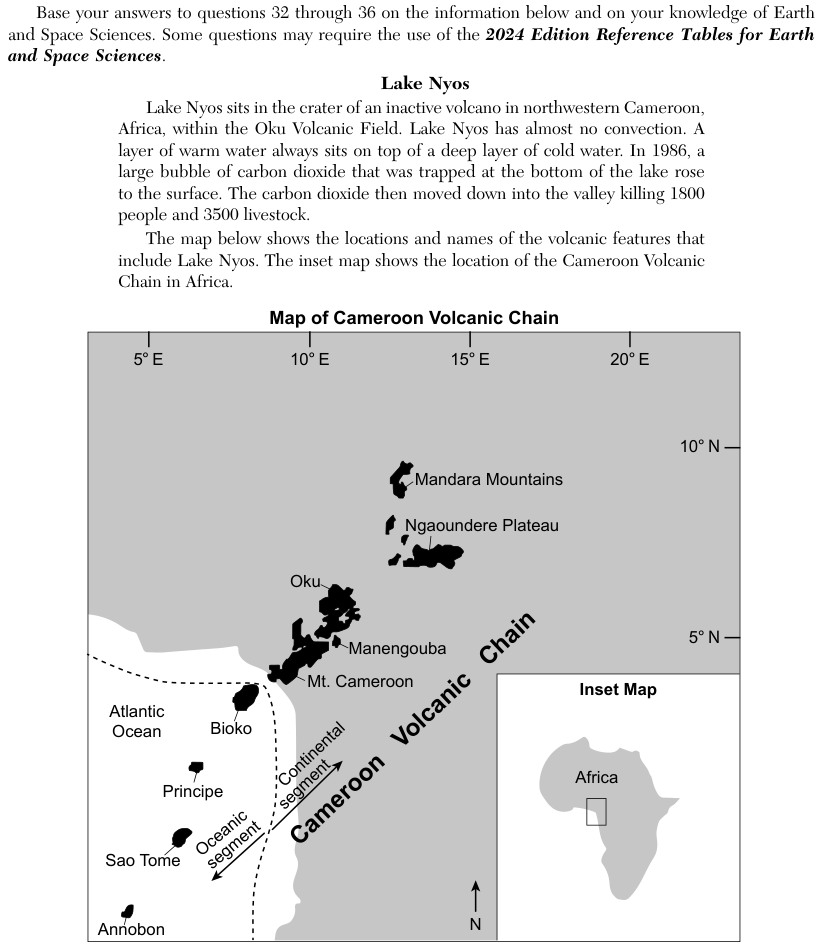
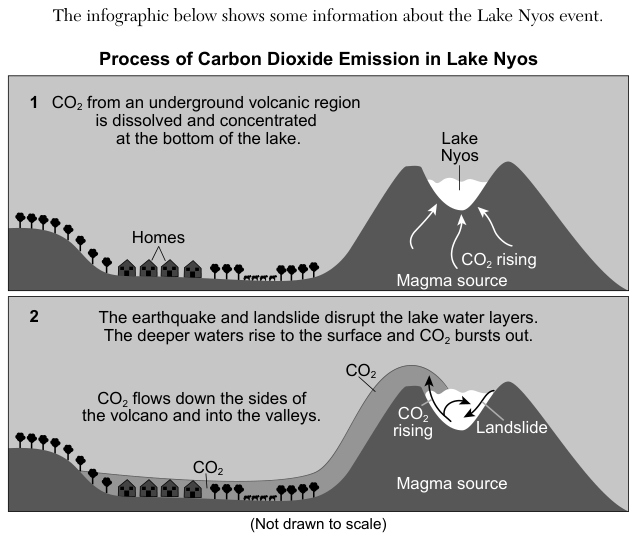
The passage says Lake Nyos sits in the crater of an inactive volcano in northwestern Cameroon, Africa. A layer of warm water sits on top of a deep layer of cold water, and in 1986 a large bubble of carbon dioxide (CO2) trapped at the bottom of the lake rose to the surface, moved down into the valley, and killed 1800 people and 3500 livestock. A map shows the Cameroon Volcanic Chain, including Oku, the volcanic field that holds Lake Nyos. An infographic, Process of Carbon Dioxide Emission in Lake Nyos, shows in panel 1 CO2 from a magma source dissolved and concentrated at the bottom of the lake, and in panel 2 an earthquake and landslide disturbing the water layers, CO2 bursting out, and CO2 flowing down the sides of the volcano and into the valleys, where homes stand.
How to think about it
Look at panel 2 of the infographic and follow the carbon dioxide from the lake to where it ended up. Then read each choice and ask whether the cause it names would make a gas move in that direction.
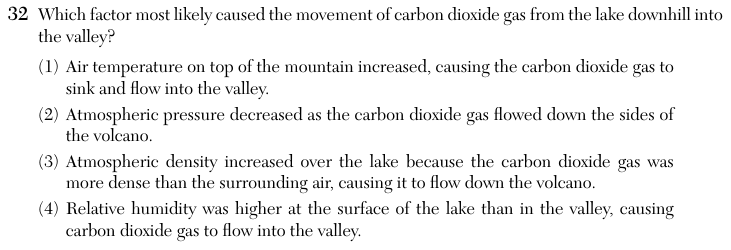
Which factor most likely caused the movement of carbon dioxide gas from the lake downhill into the valley?
Choice 3 is right. Carbon dioxide is denser than the surrounding air, so a large amount of it released at once does not rise and mix away. It sinks and flows down the slopes of the volcano along the ground, filling the low valley where the homes were.
Warmer air is less dense and tends to rise, not sink. A rise in air temperature on the mountain would not push the gas down into the valley.
Atmospheric pressure increases, not decreases, toward lower elevations. A change in pressure along the way is also not what started the gas moving downhill.
Relative humidity describes how close the air is to being saturated with water vapor. It does not make a dense gas flow downhill. This choice may come from linking the water of the lake to the movement of the gas.