Earth and Space Sciences Regents, June 2026, question 37
Tap an image to open it full size.
What the figure shows
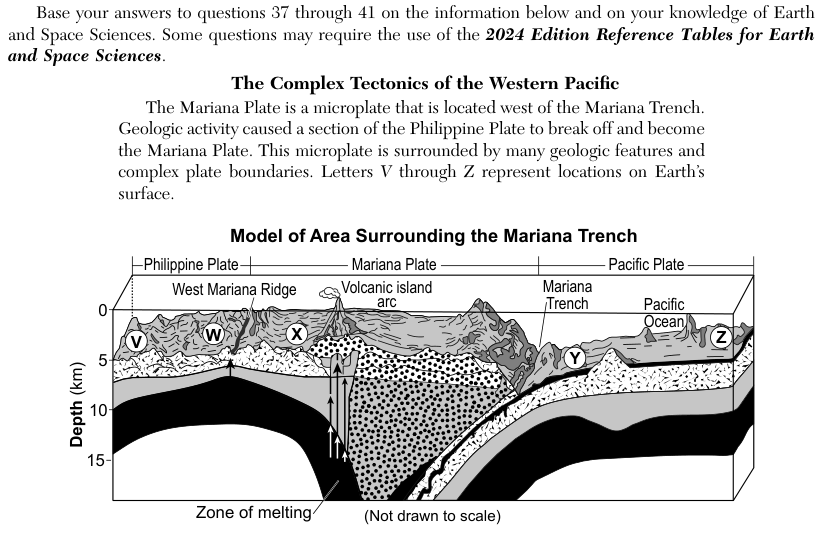
The passage, The Complex Tectonics of the Western Pacific, says the Mariana Plate is a microplate west of the Mariana Trench that broke off the Philippine Plate. The cross section, Model of Area Surrounding the Mariana Trench, runs from the Philippine Plate on the left, across the Mariana Plate, to the Pacific Plate on the right, with depth in kilometers (km) from 0 to 15. Labels show the West Mariana Ridge, a volcanic island arc with a zone of melting below it, the Mariana Trench and the Pacific Ocean. Locations V and W are on the left near the West Mariana Ridge, where a small upward arrow is drawn below the surface; X is near the volcanic island arc; Y is on the Pacific Plate next to the trench; and Z is farther east on the Pacific Plate.
How to think about it
First find the divergent boundary, where new crust forms, and the convergent boundary, where crust sinks back into the mantle. Oceanic crust forms at a divergent boundary and then moves away from it, so think about how age changes with distance from that boundary. Then test each statement: check both its age comparison and the reason it gives.
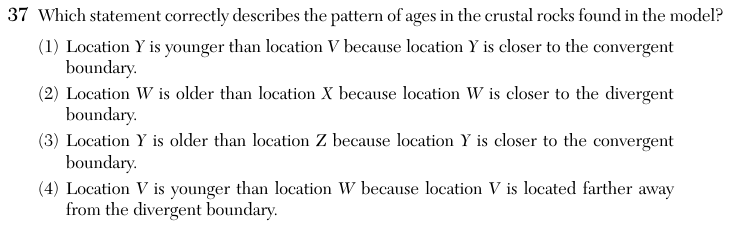
Which statement correctly describes the pattern of ages in the crustal rocks found in the model?
Choice 3 is right. Y and Z are both on the Pacific Plate, which the model shows sinking beneath the Mariana Plate at the Mariana Trench. This crust formed at a divergent boundary to the east, beyond the edge of the model, and has moved west since then. On this one plate, crust at Y has travelled farther from where it formed than crust at Z, so crust at Y is older.
On the Pacific Plate in this model, crust at Y next to the trench has moved the farthest from where it formed, so it is the oldest crust on that plate, not young crust. This choice may come from reversing the age pattern on a plate that moves toward a trench.
Crust closer to a divergent boundary is younger, because it formed more recently. Saying W is older because it is closer to the divergent boundary reverses the pattern.
Crust farther from a divergent boundary is older, not younger, because it formed earlier and has moved away since. This choice reverses the link between distance and age.