Earth and Space Sciences Regents, June 2026, question 45
Tap an image to open it full size.
What the figure shows
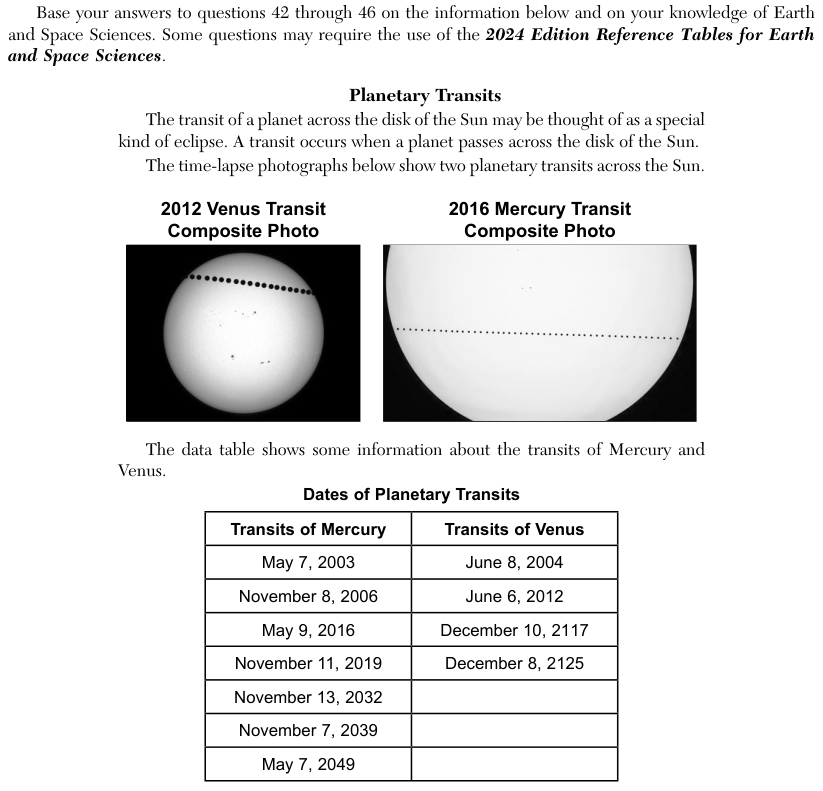
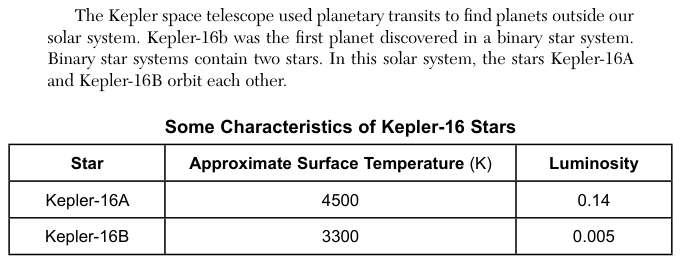
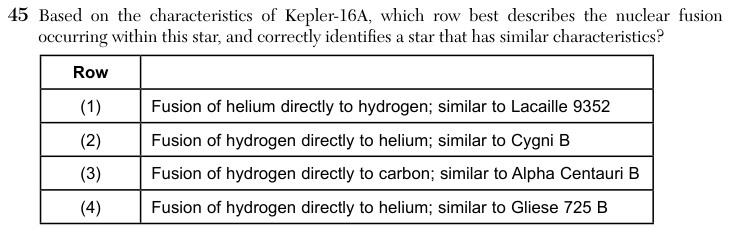
The passage says the Kepler space telescope used transits to find planets outside our solar system, and that Kepler-16A and Kepler-16B are two stars that orbit each other. The table, Some Characteristics of Kepler-16 Stars, gives Kepler-16A an approximate surface temperature of 4500 kelvin (K) and a luminosity of 0.14, and Kepler-16B 3300 K and a luminosity of 0.005. Each of the four choices names a fusion reaction and a star: helium to hydrogen with Lacaille 9352; hydrogen to helium with Cygni B; hydrogen to carbon with Alpha Centauri B; hydrogen to helium with Gliese 725 B.
How to think about it
Open the Hertzsprung-Russell (H-R) Diagram and plot Kepler-16A using its surface temperature and its luminosity. Find which group of stars it falls in and which named stars lie closest to that point. Then think about which fusion reaction powers a star in that group.
Based on the characteristics of Kepler-16A, which row best describes the nuclear fusion occurring within this star, and correctly identifies a star that has similar characteristics? Row
Choice 2 is right. On the H-R Diagram, a star with a surface temperature of 4500 K and a luminosity of 0.14 falls on the main sequence, near 61 Cygni B, which has a luminosity of about 0.1 and a temperature of about 4000 K. Main sequence stars produce their energy by fusing hydrogen into helium in their cores.
Stars fuse lighter elements into heavier ones, so hydrogen becomes helium, not the other way round. Lacaille 9352 is also dimmer and cooler than Kepler-16A on the H-R Diagram.
A main sequence star fuses hydrogen into helium. Carbon forms later, when helium fuses, not directly from hydrogen. Alpha Centauri B is also much brighter than Kepler-16A, with a luminosity close to 1.
The fusion part is correct, but Gliese 725 B is much dimmer and cooler than Kepler-16A, with a luminosity of about 0.01. Its position is closer to that of Kepler-16B. This choice may come from using the data for the wrong star.