Earth and Space Sciences Regents, June 2026, question 48
Tap an image to open it full size.
What the figure shows
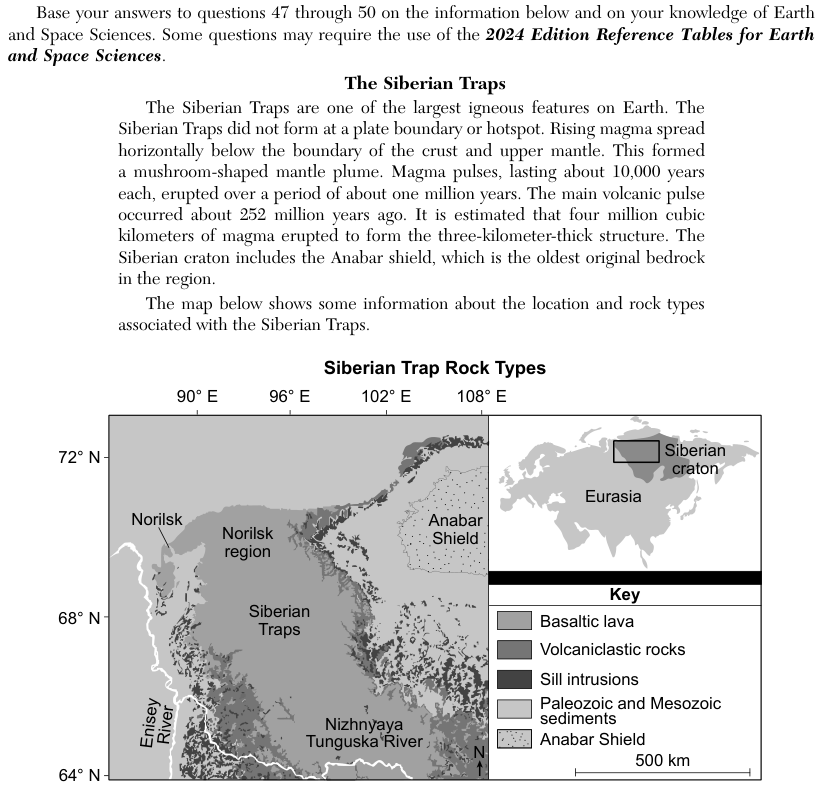
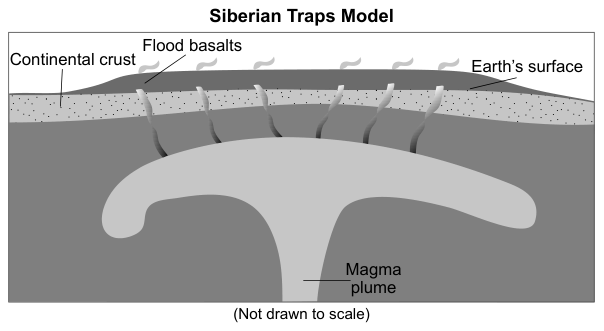
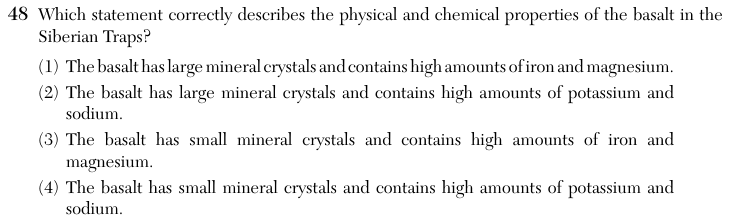
The passage describes the Siberian Traps, one of the largest igneous features on Earth, formed when magma from a mushroom-shaped mantle plume erupted about 252 million years ago. A map labelled "Siberian Trap Rock Types" shows basaltic lava, volcaniclastic rocks, sill intrusions, sediments and the Anabar Shield. A cross section labelled "Siberian Traps Model" shows a magma plume below continental crust and flood basalts lying on Earth's surface. The four choices pair large or small mineral crystals with high amounts of either iron and magnesium or potassium and sodium.
How to think about it
The question asks about two properties, so settle each one separately. For crystal size, use the model to see where the basalt cooled, then think about how cooling speed controls crystal size. For chemistry, open the Mineral Composition of Igneous Rocks chart and follow the arrows at its base to see which elements increase toward the column that holds basalt.
Which statement correctly describes the physical and chemical properties of the basalt in the Siberian Traps?
Choice 3 is right. The model shows the flood basalts poured out onto Earth's surface as lava, where they cooled quickly, so the mineral crystals had little time to grow and are small. The Mineral Composition of Igneous Rocks chart places basalt in the mafic column, and the arrow for iron (Fe), magnesium (Mg) and calcium (Ca) increases toward that side.
The chemistry is right, but large crystals form when magma cools slowly deep underground, as in gabbro. This choice may come from mixing up basalt with gabbro, its slow-cooled partner in the same mafic column.
Both parts are wrong. Large crystals and high potassium and sodium describe granite, a felsic rock that cools slowly underground. It may come from reading the potassium (K) and sodium (Na) arrow in the wrong direction.
Small crystals fit lava that cooled at the surface, but high potassium and sodium belong to felsic rocks such as rhyolite. This choice may come from reading the potassium (K) and sodium (Na) arrow in the wrong direction, since that arrow points away from basalt.