Earth and Space Sciences Regents, August 2026, question 1
Tap an image to open it full size.
What the figure shows
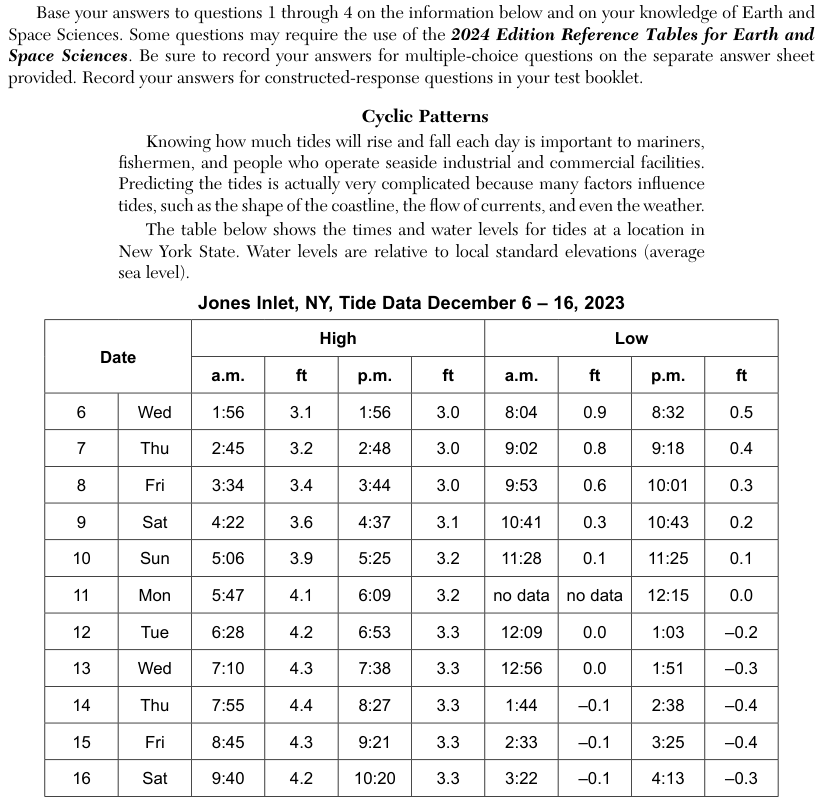
A table, Jones Inlet, NY, Tide Data December 6 to 16, 2023, lists for each day the times and water levels in feet (ft) of the morning (a.m.) and afternoon or evening (p.m.) high tides and low tides. Water levels are relative to local standard elevation (average sea level). For example, on December 6 the high tides are at 1:56 a.m. (3.1 ft) and 1:56 p.m. (3.0 ft), and the low tides at 8:04 a.m. (0.9 ft) and 8:32 p.m. (0.5 ft). The a.m. low tide for December 11 reads "no data".
How to think about it
A cyclic change is one that repeats over and over at a regular interval. For each statement, first check against the table whether it is true. Then ask whether it describes an event that repeats at a steady interval. Work out a few time gaps from the table yourself, counting hours and minutes across noon and midnight.
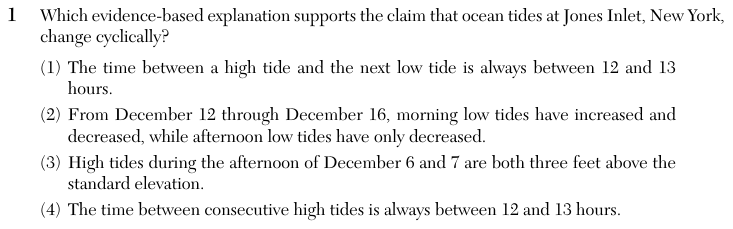
Which evidence-based explanation supports the claim that ocean tides at Jones Inlet, New York, change cyclically?
Choice 4 is right. On December 6 the high tides come at 1:56 a.m. and 1:56 p.m., 12 hours apart, and the next high tide is at 2:45 a.m. on December 7, 12 hours 49 minutes later. Every pair of consecutive high tides in the table is 12 to 13 hours apart. An event that repeats at the same interval again and again is a cycle.
A high tide and the next low tide are only about 6 hours apart. For example, the 1:56 a.m. high tide on December 6 is followed by the 8:04 a.m. low tide. This choice may come from mixing up the gap from high to low with the gap from one high tide to the next.
This statement does not match the table. From December 12 to 16 the morning low tides read 0.0, 0.0, -0.1, -0.1 and -0.1 ft, so they never rise. The afternoon low tides fall from -0.2 to -0.4 ft and then rise to -0.3 ft. It may come from reading the two columns the wrong way round.
The statement is true: both afternoon high tides read 3.0 ft. But two equal readings on two days do not show a pattern that repeats over time, so they give no evidence of a cycle.