Earth and Space Sciences Regents, August 2026, question 2
Tap an image to open it full size.
What the figure shows
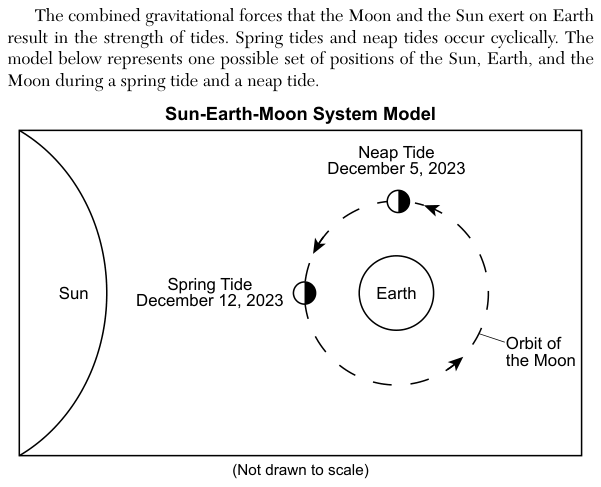
A Sun-Earth-Moon System Model (not drawn to scale) shows the Sun on the left, Earth in the center, and the Moon's orbit as a dashed circle around Earth, with arrows showing the Moon moving counterclockwise. One Moon position, at the top of the orbit at a right angle to the Sun-Earth line, is labeled "Neap Tide December 5, 2023". A second Moon position, on the side of the orbit facing the Sun, is labeled "Spring Tide December 12, 2023". The passage says the combined pull of the Moon and the Sun sets the strength of tides, and that spring tides and neap tides occur cyclically.
How to think about it
Look at where the Moon sits in the model for each kind of tide, relative to the Sun and Earth. Then recall which Moon phase we see from Earth when the Moon is in that position. The four main Moon phases are new, first quarter, full and third quarter.
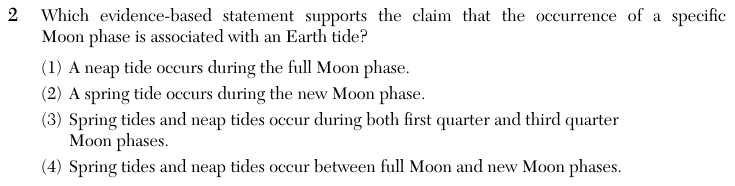
Which evidence-based statement supports the claim that the occurrence of a specific Moon phase is associated with an Earth tide?
Choice 2 is right. In the model the Moon at the spring tide on December 12 lies between Earth and the Sun. In that position the lit side of the Moon faces away from Earth, so we see a new Moon. The Sun and Moon then pull along the same line, which gives the large tidal range of a spring tide.
At full Moon the Sun, Earth and Moon are also in a straight line, with Earth in the middle. The Sun and Moon pull along the same line, so full Moon gives a spring tide, not a neap tide. This choice may come from linking neap tides with any phase other than new Moon.
At first quarter and third quarter the Moon is at a right angle to the Sun-Earth line, as at the neap tide position in the model. These phases give neap tides only, not spring tides, so the statement mixes up the two kinds of tide.
Spring tides happen at new Moon and full Moon, and neap tides at the quarter phases, not in the days between them. This statement names no single phase, so it does not link a specific phase with a specific tide.