Earth and Space Sciences Regents, August 2026, question 4
Tap an image to open it full size.
What the figure shows
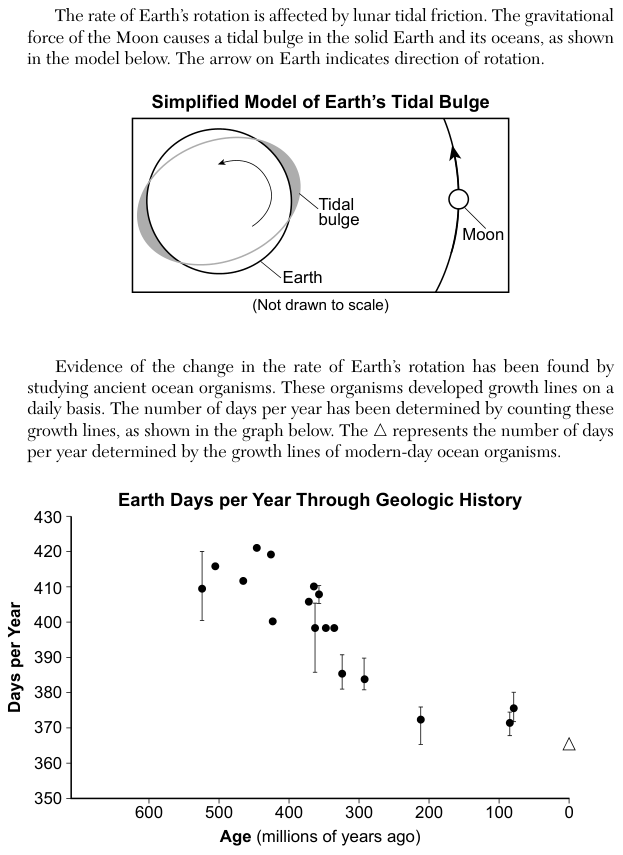
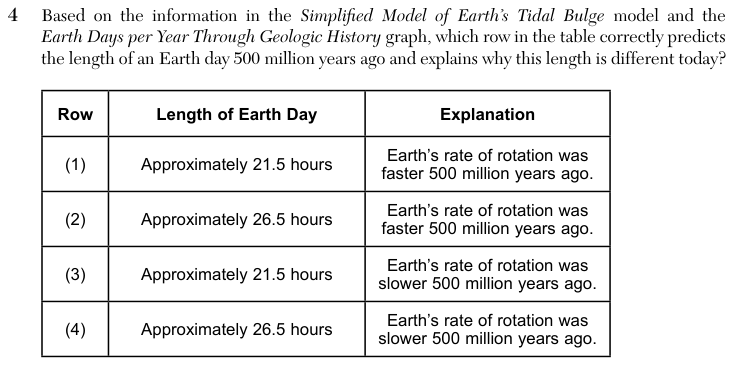
The Simplified Model of Earth's Tidal Bulge (not drawn to scale) shows Earth with a gray tidal bulge, an arrow on Earth showing its direction of rotation, and the Moon on its orbit to the right. The passage says the rate of Earth's rotation is affected by lunar tidal friction. A graph, Earth Days per Year Through Geologic History, plots days per year (350 to 430) against age in millions of years ago (600 to 0), counted from daily growth lines in ancient ocean organisms. Points near 500 to 520 million years ago lie at about 410 to 416 days per year, the points fall toward the right, and a triangle at 0 marks about 365 days per year for modern organisms. The table in the question gives two day lengths, about 21.5 hours and about 26.5 hours, each paired with one of two explanations: Earth's rotation was faster, or slower, 500 million years ago.
How to think about it
Read the graph at 500 million years ago to find the number of days in a year then. A year is the time Earth takes to go once around the Sun, which is about the same number of hours then as now. Divide the hours in one year by the number of days per year to get the hours in one day. Then think about what that day length means for how fast Earth was spinning.
Based on the information in the Simplified Model of Earth’s Tidal Bulge model and the Earth Days per Year Through Geologic History graph, which row in the table correctly predicts the length of an Earth day 500 million years ago and explains why this length is different today? Row Length of Earth Day Explanation