Earth and Space Sciences Regents, January 2026, question 20
Tap an image to open it full size.
What the figure shows
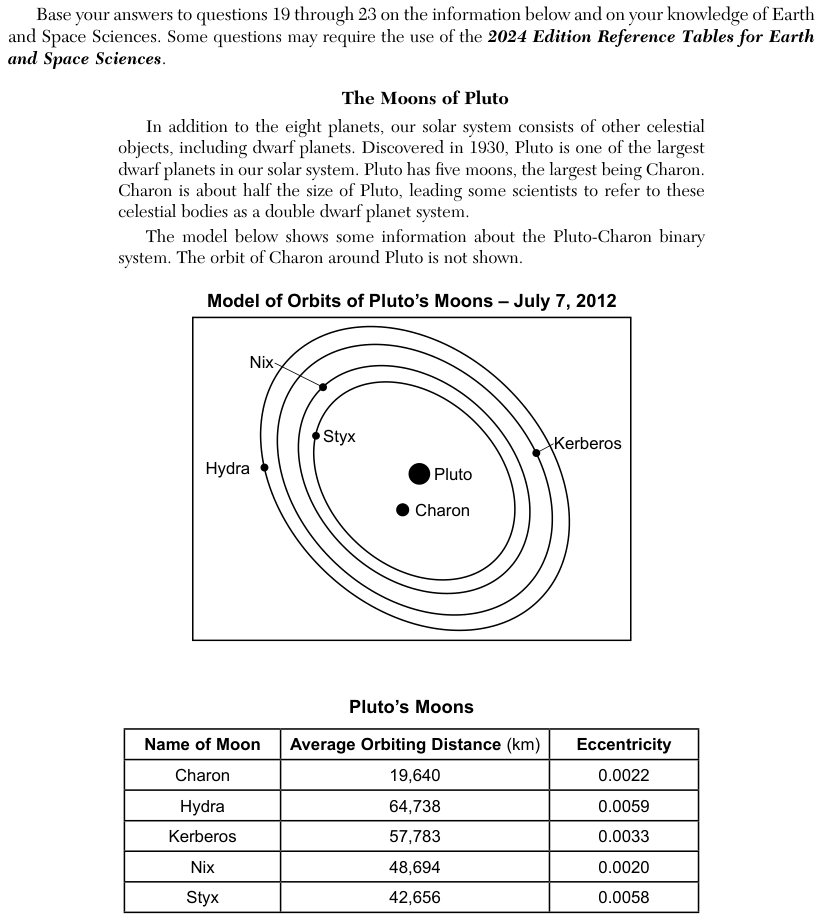
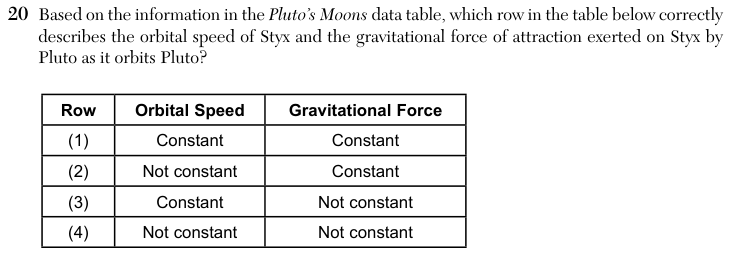
The passage table Pluto's Moons lists five moons with their average orbiting distance in kilometers (km) and the eccentricity of each orbit. Styx has an average orbiting distance of 42,656 km and an eccentricity of 0.0058. A model titled Model of Orbits of Pluto's Moons, July 7, 2012, draws the orbits of Styx, Nix, Kerberos and Hydra as ovals around Pluto. The question table has four rows, each giving Orbital Speed and Gravitational Force as either Constant or Not constant.
How to think about it
Start with the eccentricity of the orbit of Styx in the table. Ask whether that value describes a perfect circle or an ellipse. Then think about how the distance between Styx and Pluto behaves along that path, and how both speed and gravitational force depend on that distance.
Based on the information in the Pluto’s Moons data table, which row in the table below correctly describes the orbital speed of Styx and the gravitational force of attraction exerted on Styx by Pluto as it orbits Pluto? Row Orbital Speed Gravitational Force