Earth and Space Sciences Regents, January 2026, question 21
Tap an image to open it full size.
What the figure shows
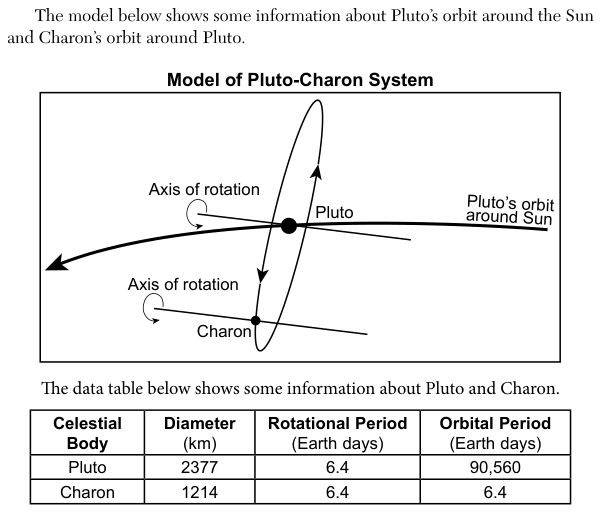
The Model of Pluto-Charon System shows Pluto moving along its orbit around the Sun, with Charon moving in a separate loop around Pluto; both bodies have a labeled axis of rotation. A data table gives Pluto a diameter of 2377 kilometers (km), a rotational period of 6.4 Earth days and an orbital period of 90,560 Earth days. It gives Charon a diameter of 1214 km, a rotational period of 6.4 Earth days and an orbital period of 6.4 Earth days.
How to think about it
Phases of a moon seen from a planet depend on how the positions of the Sun, the planet and the moon change. List each motion shown in the model and each period in the table. Then compare each one with the length of the phase cycle of Charon seen from Pluto.
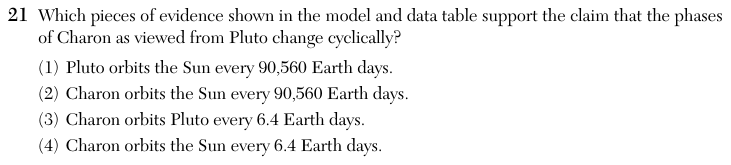
Which pieces of evidence shown in the model and data table support the claim that the phases of Charon as viewed from Pluto change cyclically?
Choice 3 is right. The model shows Charon moving in a loop around Pluto, and the table gives Charon's orbital period as 6.4 Earth days. Each time Charon goes once around Pluto, the lit part seen from Pluto goes through the same sequence of phases. A motion that repeats every 6.4 days makes the phases repeat in a cycle.
This statement is true, but it describes Pluto's motion around the Sun. The phases of Charon seen from Pluto depend on Charon moving around Pluto, which repeats much more often.
Charon travels around the Sun together with Pluto, so 90,560 Earth days also describes Charon's path around the Sun. But a motion that long cannot produce the much shorter phase cycle, which comes from Charon's orbit around Pluto.
The model shows Charon moving around Pluto, so its 6.4-day orbital period is the time to go around Pluto, not around the Sun. This choice mixes up the object that Charon orbits.