Earth and Space Sciences Regents, January 2026, question 46
Tap an image to open it full size.
What the figure shows
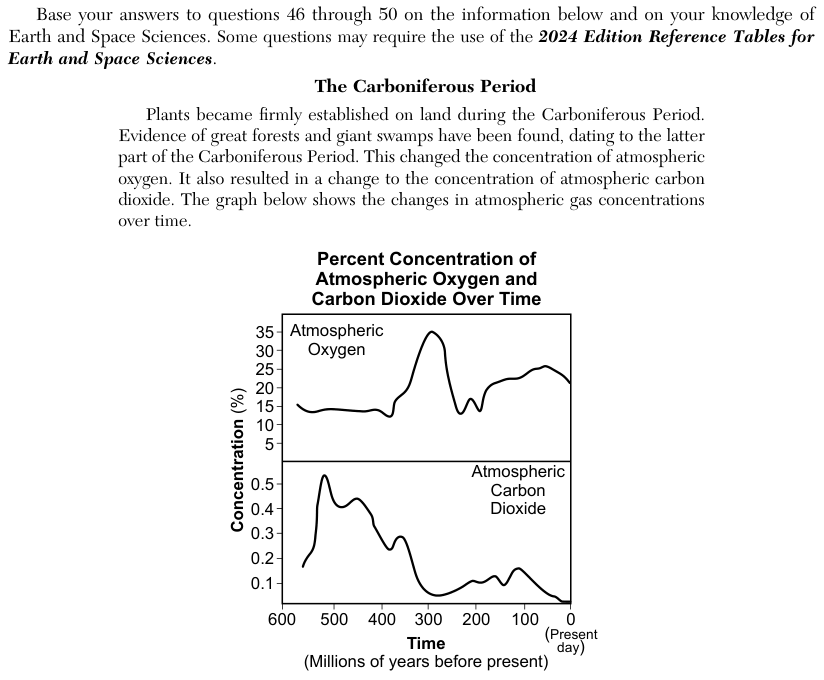
The passage, titled The Carboniferous Period, says that plants became firmly established on land during this period and that great forests and giant swamps date to its later part. It says this changed the amount of oxygen and of carbon dioxide in the atmosphere. The graph, Percent Concentration of Atmospheric Oxygen and Carbon Dioxide Over Time, shows concentration in percent (%) against time from 600 million years ago to the present day. Oxygen stays near 13 to 15% until about 360 million years ago, rises to a peak of about 35% near 300 million years ago, then falls; carbon dioxide falls from about 0.3% to below 0.1% over the same span.
How to think about it
Find when the Carboniferous Period happened in the Geologic History of New York State table, then read the oxygen curve over those years. Next, recall what each process named in the choices does to the oxygen in the air: does it add oxygen, use it up, or neither? Compare that with what the passage says happened to plant life on land.
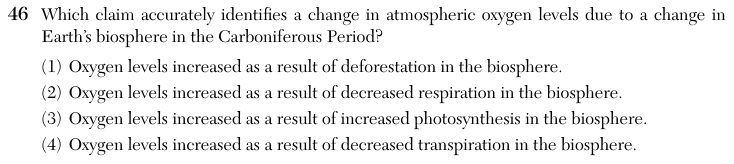
Which claim accurately identifies a change in atmospheric oxygen levels due to a change in Earth’s biosphere in the Carboniferous Period?
Choice 3 is right. The Carboniferous Period lasted from 359 to 299 million years ago, and over that time the oxygen curve rises from about 15% to about 35%. The passage says great forests and swamps spread on land then. Plants release oxygen during photosynthesis, so more plants carrying out photosynthesis raised the oxygen in the atmosphere.
Deforestation means the loss of forests. The passage describes the opposite: forests spread across the land. Fewer trees would mean less photosynthesis and less oxygen released, not more.
Respiration uses oxygen, so less respiration would leave a little more oxygen in the air. But the passage gives no evidence that respiration decreased. More plants and animals would carry out more respiration, not less. This choice may come from linking oxygen to respiration without checking what the passage says changed.
Transpiration is the release of water vapor from plant leaves. It does not add or remove oxygen. More plants would also mean more transpiration, not less. This choice may come from mixing up transpiration with photosynthesis.